foam monitor seal leaks is the first checkpoint buyers should lock before they approve a supplier, budget, or production slot. Foam monitor leaking is the first red flag a buyer should check before signing off on a supplier. A leaking turret isn’t just a puddle on the floor. It threatens your annual NFPA 25 flow test and can fast-track you to a failed inspection. The turret shaft seal is the most common failure point. The good news? Most don’t require a $5,000 to $15,000 monitor replacement. A seal kit costs under $300.annual NFPA 25 flow test
The real shift hitting buyers in 2026 is chemical compatibility. Standard Buna-N (NBR) seals are failing against PFAS-free foams and alcohol-resistant (AR-AFFF) concentrates. The Navy’s PFAS transition directive forced a material upgrade. Same logic applies to your industrial systems. Switching to an FKM (Viton) seal costs more but extends service life. Let’s walk through the six most common causes of a foam monitor leaking — from a galled check valve ball to a nicked O-ring — with the exact fix for each.The Navy’s PFAS transition directive

Foam Monitor Anatomy: Where Leaks Occur
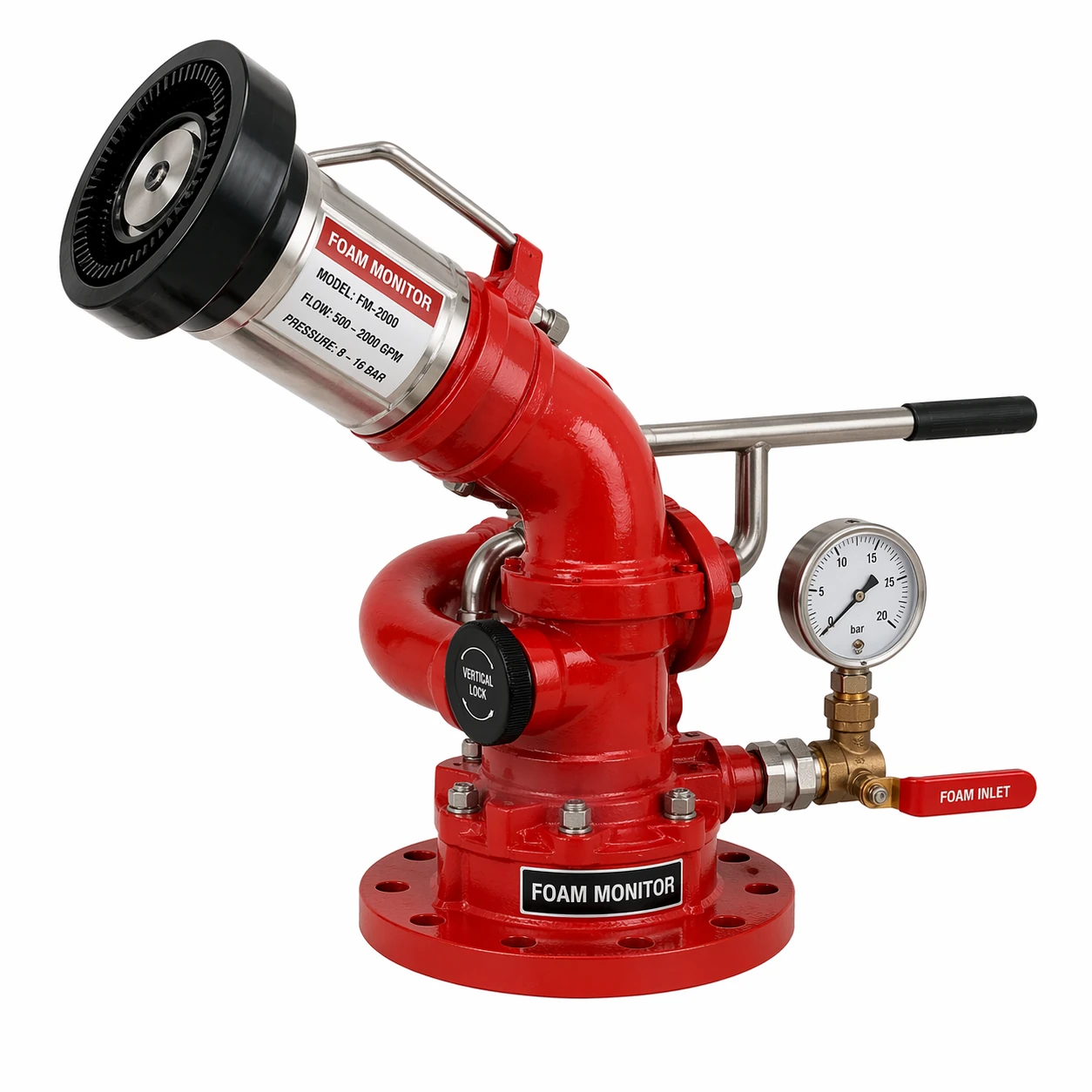
Most leaks occur at four points: the turret shaft seal, the foam inlet check valve gasket, the discharge flange connection, and the weep port. A bubble test at 150 PSI pinpoints the exact site.
The turret shaft seal sits between the rotating and stationary parts of the monitor. It’s the most common failure point because it sees constant motion and foam concentrate residue. The foam inlet check valve gasket leaks when the valve body cracks or the gasket hardens from chemical exposure. The discharge flange connection typically leaks only if bolts loosened during thermal cycling or the gasket was pinched during installation. The weep port is a deliberate drain — if it flows continuously during operation, the primary shaft seal has failed and needs replacement.
A worn shaft seal can often be replaced on-site with a seal kit. Don’t replace the entire turret until you’ve ruled out the seal.
Seal Material Selection: Chemical Compatibility Matters
Standard Buna-N seals fail rapidly with AR-AFFF and fluorine-free foams. The fix is an FKM (Viton) upgrade.
The culprit behind those shaft seal failures is often chemical incompatibility, not mechanical wear. When the Navy mandated a PFAS transition in 2022, facility managers discovered their Buna-N (NBR) seals were dissolving in alcohol-resistant (AR-AFFF) and fluorine-free (F3) foam concentrates.
For any foam monitor repair on a NFPA 16 system, standard Buna-N is no longer the safe default. Specify FKM (Viton) seals. Viton resists the aggressive solvents in modern foam concentrates and holds up across -20°F to +400°F. The upgrade costs more at the parts counter but delivers a longer service life — meaning fewer emergency callbacks and lower lifetime cost.foam monitor repair
A common mistake during seal replacement? Using aggressive solvents to clean the seal cavity. That stuff degrades FKM elastomers fast. Clean the cavity with CRC QD Contact Cleaner instead—it leaves no residue and won’t attack the new seal. One more detail people miss: never use lithium-based grease on the seal face. Stick with silicone grease. Lithium-based grease can cause foam knockdown and accelerate seal failure.
| Seal Material | Buna-N (NBR) | FKM (Viton) | Why It Matters |
|---|---|---|---|
| Chemical Resistance | Poor with AR-AFFF & F3 foams | Excellent with all foam types | Prevents seal swelling & failure |
| Temperature Range | -30°F to +250°F | -20°F to +400°F | Handles extreme ambient & process heat |
| Service Life vs. Buna-N | Baseline | Longer | Reduces MTBF risk & downtime |
| Cost Premium | Standard (OEM) | Higher upfront cost | ROI: <$300 kit vs. $5k+ replacement |
| Compatibility | Legacy AFFF only | PFAS-free & AR foams | Future-proofs NFPA 16 systems |

Step-by-Step: Replace Turret Shaft Seal
Shaft seal failure is the most common cause of foam monitor leaks. A $300 seal kit replaces a $15,000 turret.
The math is brutal. A complete monitor replacement runs $5,000 to $15,000. A seal kit costs under $300. The difference is a correct diagnosis. Most leaks aren’t a cracked housing or a dead eductor—they’re a worn O-ring at the turret shaft or a loose gasket at the foam inlet check valve. We’ve seen distributors scrap entire assemblies over an $8 check valve ball that was merely galled, not broken.
Here are the six causes we find on site, ranked by frequency, with the fix and the cost.
- Deteriorated turret shaft seal (most common failure): The seal between the rotating barrel and stationary body degrades from abrasive foam residue. Fix: Replace with FKM (Viton) seal. Cost: $50–$200 for seal kit. Time: 30 minutes.FKM (Viton) seal
- Loose or galled foam inlet check valve gasket: The valve appears closed but the ball is stuck or the gasket is compressed. Fix: Remove, clean, or replace ball ($8 vs. $120 for a new valve).
- Discharge flange connection leak: Loose bolts or degraded gasket at the nozzle flange. Fix: Tighten to 30 ft-lbs or replace the gasket.
- A weep port leak means the internal seal has failed and water is bypassing the drain. Replace the shaft seal assembly.
- An eductor or Venturi blockage creates back-pressure leaks. Foam residue clogs the Venturi, forcing pressure back through the seals. Soak the eductor in a 50/50 white vinegar solution for 2 hours.
- Standard Buna-N (NBR) seals fail fast with alcohol-resistant AR-AFFF or fluorine-free F3 foams. Upgrade to FKM (Viton) rated from -20°F to +400°F with full chemical resistance.
The Navy’s 2022 PFAS directive forced this issue, but many OEMs still ship Buna-N seals. If your client runs F3 or AR-AFFF, expect faster seal failure. A Viton upgrade costs more but lasts longer. You sell a longer MTBF, not just a part.
Check Valve & Eductor Blockage as Leak Source
A leaking foam monitor is rarely a housing crack. Most leaks trace back to a worn shaft seal or a loose check valve gasket—a repair that costs under $300, not $15,000.
The shaft seal is the most common failure point. That seal sits between the rotating turret and the stationary body. When it fails, you get a steady drip—or a stream at the turret base. The second most common leak is the foam inlet check valve gasket. Loose bolts or a galled ball create a weep path that throws off the entire foam proportioning ratio.
Here is the cost math: a complete monitor replacement runs $5,000 to $15,000. A seal kit costs under $300. The numbers favor the repair.
The material gap is where most distributors lose money. Standard OEM seals use Buna-N. That was fine with legacy AFFF, but PFAS-free and alcohol-resistant foams eat Buna-N alive. Upgrade to FKM. It costs more upfront but lasts longer.
- Shaft seal at the turret base. Most common failure point. Foam residue abrades the lip seal over time. Replace with FKM rated for -20°F to +400°F.
- Foam inlet check valve gasket. Second most common. Loose bolts or a galled ball create a weep path. Tighten to spec first. If it still leaks, inspect the ball surface.
- Discharge flange connection. Usually a loose bolt or a nicked O-ring. Common sizes: #113 for 1.5-inch monitors, #213 for 2-inch.
- Weep port. Designed to drain condensation. If it leaks under pressure, the shaft seal above it has failed.
Here’s an insider tip most manuals skip: many O-ring failures are installation errors, not material fatigue. A technician nicks the seal on a sharp edge during assembly. Or they use lithium grease on the seal face—that reacts with foam concentrate and causes knockdown. The right lubricant is silicone grease, applied lightly. And when cleaning the seal cavity, skip the brake cleaner. It degrades FKM. Use CRC QD Contact Cleaner—no residue, no rubber attack.
Preventive Maintenance Schedule for Fire Monitors
Shaft seal failure is the most common cause of foam monitor leaks. A $300 seal kit saves you a $15,000 replacement.
Here is a common, expensive mistake. A distributor takes a call about a leaking monitor on a fixed deluge system. First instinct: quote a full turret replacement at $5,000 to $15,000. That move is almost always wrong. The leak is rarely a cracked housing. It is almost always a seal or a check valve.
A leaking foam monitor has four common leak points: the turret shaft seal (where rotating meets stationary), the foam inlet check valve gasket, the discharge flange connection to the nozzle, and the weep port. A bubble test at 150 PSI pinpoints the exact site in under five minutes. The most common cause is shaft seal failure from abrasive foam residue.
Standard Buna-N (NBR) seals don’t last against alcohol-resistant (AR-AFFF) or fluorine-free (F3) foams. They degrade fast. The Navy’s 2022 PFAS transition directive forced seal upgrades across every fixed system they operate. For NFPA 16 foam monitors, specify FKM (Viton) seals rated for -20°F to +400°F. The upgrade costs more — but it lasts longer. The math is simple if your target is a 5-year MTBF.
Here’s what you need for a turret shaft seal swap: 1/4″ and 5/16″ hex keys, a soft mallet, a seal puller, and silicone grease. Isolate the system and depressurize first. Pull the turret top cap (4 bolts). Extract the C-clip and work the old seal out with an O-ring pick. Clean the seal cavity with CRC QD Contact Cleaner — skip the aggressive solvents, they’ll wreck FKM seals. Lubricate the new FKM seal with silicone grease and tap it home with a soft mallet. Most field repairs wrap up in under 30 minutes.
Flow weak or sputtering even though the foam mixes? The foam inlet check valve (ball type) or eductor (Venturi) is likely clogged. Pull the check valve following the manufacturer’s steps. Soak it in a 50/50 white vinegar and water solution for 2 hours — that dissolves the foam residue scale. A stuck ball is the one most people miss. The valve looks closed but it’s just galled. Cleaning the ball costs zero. Replacing it costs $8. A whole new valve runs $120.
NFPA 25 requires annual flow testing and visual inspection of fixed monitors. Internally, the shaft seal needs inspection every 5 years or after 100 hours of operation — whichever comes first. Track seal age. Record the install date and the date of first leak. Smart distributors stock a PM kit: seal, O-rings, Teflon tape, check valve ball. It simplifies restocking and cuts down emergency calls. Reactive parts sellers can’t compete with that.
- Seal material—Buna-N (NBR) vs. FKM (Viton). Viton costs more upfront. It outlasts Buna-N in foam concentrate service.
- Pressure rating: 150 PSI hydrostatic test. That’s the bare minimum for most industrial foam monitors. If your supplier can’t hit that number, walk away.
- Viton handles -20°F to +400°F without losing flexibility. Buna-N starts degrading past 250°F. That’s the difference between a gasket that seals and one that leaks mid-season.
- Common O-ring sizes: #113 for 1.5″ monitors, #213 for 2″. Stock those two and you cover the most common field repairs. No need to buy the full size matrix.
- Check valve ball replacement costs $8 for the ball. A whole new valve runs $120. The math is simple—smart distributors stock the ball.
Conclusion
A $300 seal kit stops a foam monitor leak cold. That saves you a $15,000 replacement and clears your NFPA 25 inspection. The shaft seal is the most common failure—a 30-minute fix with the right FKM upgrade. Don’t scrap the whole monitor over a $300 part.
Check the seal material on that monitor. Then grab a compatible seal kit — or a full PM kit — for the next site visit.
Frequently Asked Questions
Why is my foam cannon leaking?
A foam cannon leaking is almost always a worn or incompatible shaft seal, not a cracked housing. Replace the seal with an FKM (Viton) kit before assuming the monitor is scrap.
How does a foam monitor work?
A foam monitor projects a stream of foam solution over long distances by mixing water and foam concentrate at a controlled ratio, then discharging it through a nozzle. The turret rotates. Check your system’s proportioner and nozzle type for proper foam generation.
Will hot glue stop a leak?
No, hot glue will not stop a foam monitor turret seal leak under operational pressure. The seal area sees 150 PSI and chemical exposure that will instantly. Use a proper FKM seal kit or call a service technician for a permanent fix.
Do you fill foam cannons with water?
No, you do not fill foam cannons with water alone; they require a foam concentrate mixed with water at the correct ratio, typically 1% or 3%. Using only water will not. Always verify your foam concentrate type and proportioner setting before operation.
Are there still skeletons in the Titanic wreck?
That question is unrelated to fire equipment, but to redirect: no human skeletons remain visible at the Titanic wreck site due to deep-sea conditions. For your foam monitor, focus on checking. Stick to seal kits and chemical compatibility for your monitor repair.