
Wet-barrel pillar hydrants
Commercial, industrial and municipal outdoor networks in warm-climate installations.
- DN80 to DN150
- Single or dual outlet
- 1.0 to 1.6 MPa
- Ductile iron / bronze
If you are specifying or sourcing fire hydrants for a network, the decision on this page is which of six routes fits your site: wet or dry barrel, wall or landing point, or a monitor. Two of them differ only by whether the ground freezes, and one is not measured in bore at all. The numbers you need are here rather than behind an email.
Product range
Wet-barrel and dry-barrel pillar hydrants share the same DN80 to DN150 bore and the same 1.0 to 1.6 MPa rating. They are not interchangeable, and the difference is not on any spec sheet. Answer this before comparing anything else.
The barrel stays charged to the outlet. Faster to put into service and simpler to maintain, because there is no drain mechanism to check.
Choose when the installation never sees sustained freezing.
The control valve sits below frost line and the barrel drains after use. More parts, more inspection, and the only route that survives a hard winter.
Choose when the site freezes. A wet barrel in that ground splits.
Commercial, industrial and municipal outdoor networks in warm-climate installations.
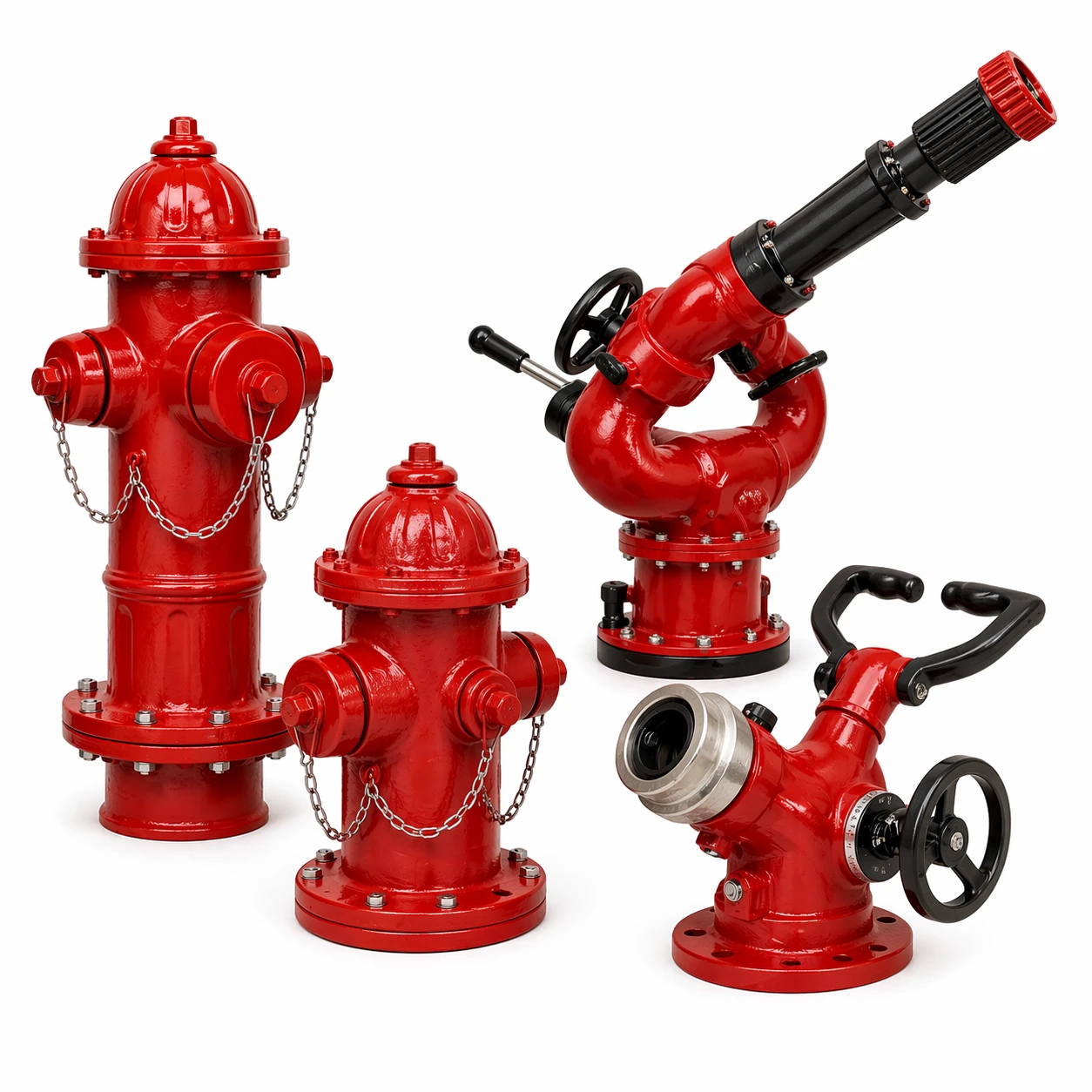
Outdoor networks where freezing conditions require the barrel to drain between uses.
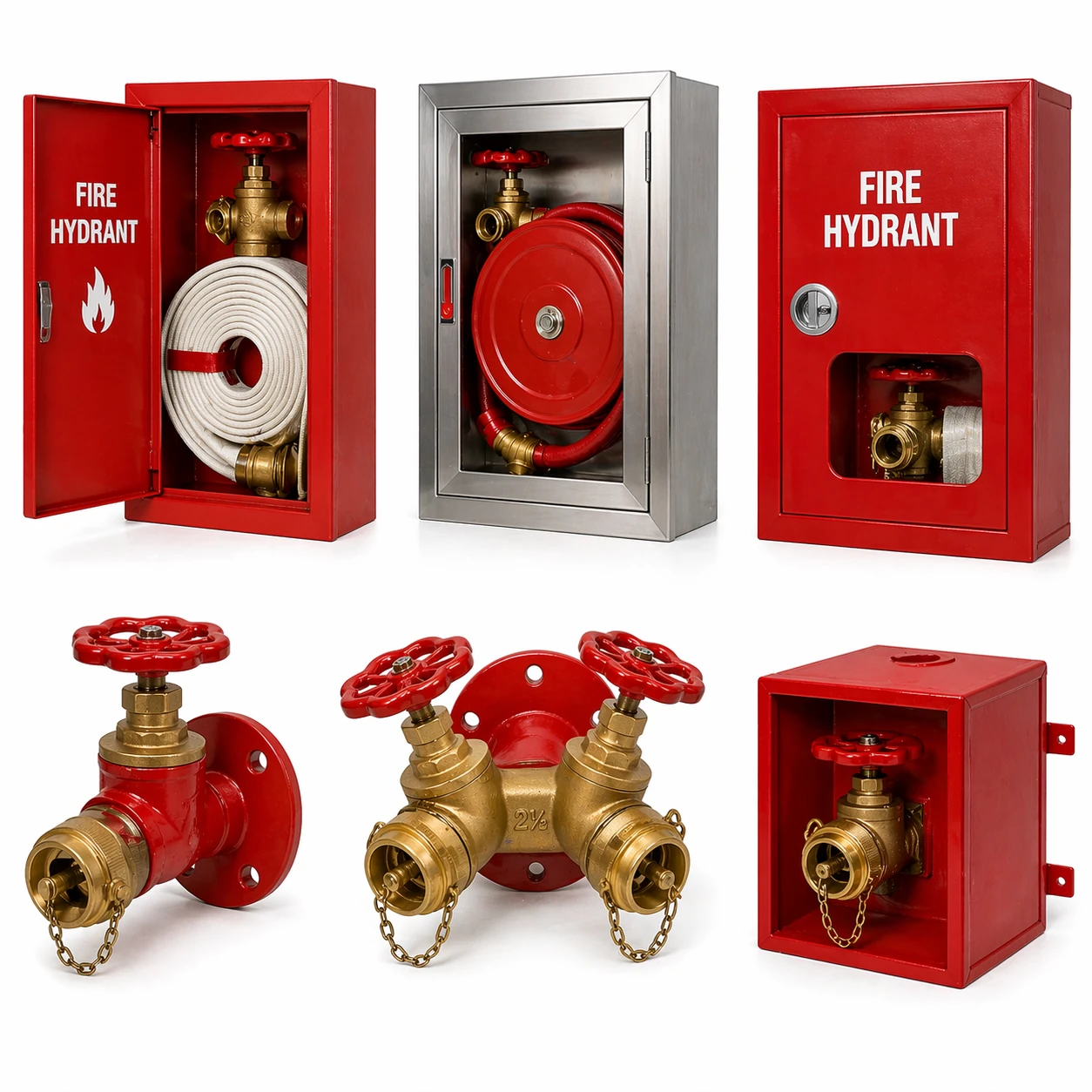
Residential estates, commercial complexes and industrial building networks where the point sits on a wall rather than in the ground.
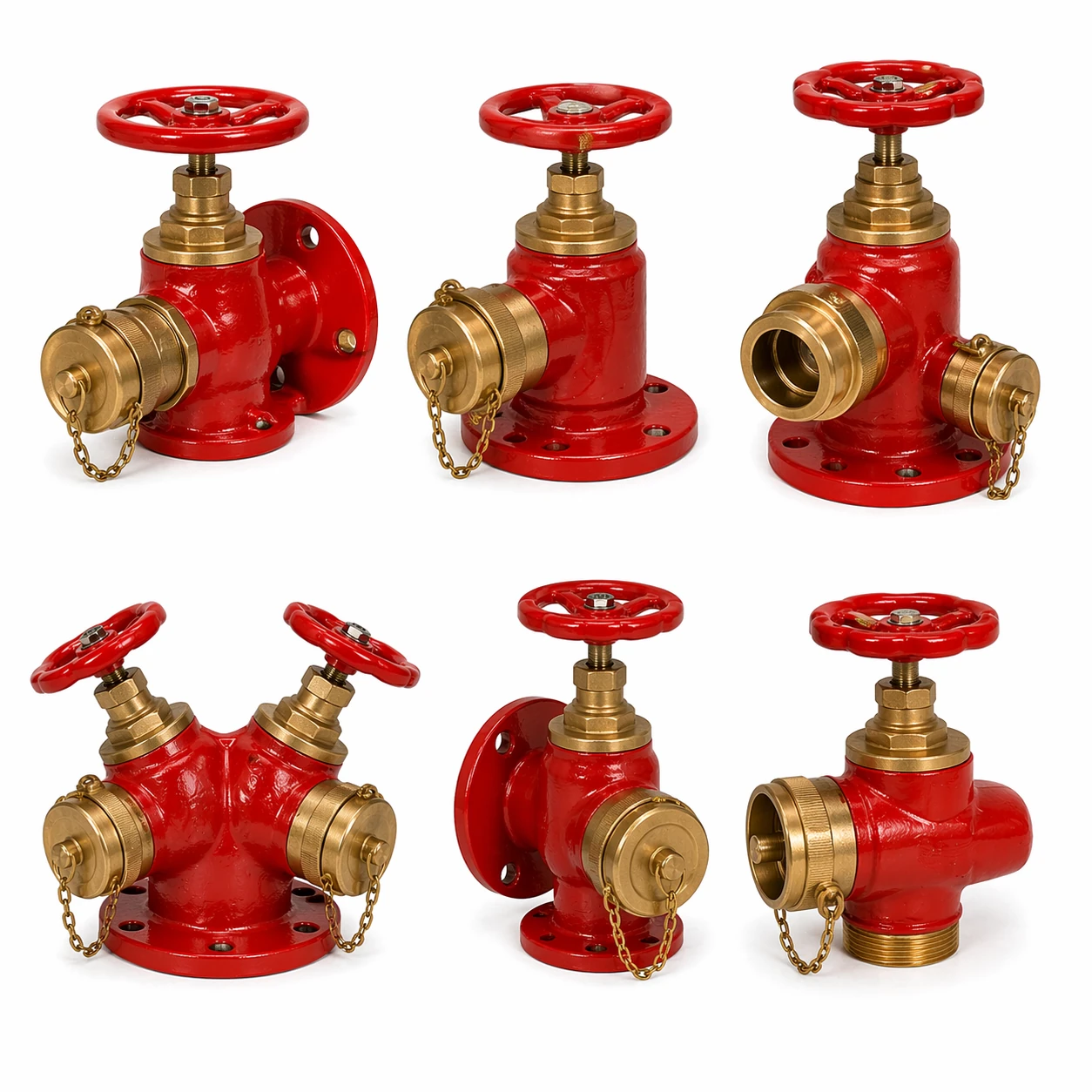
Building riser systems. The outlet connection decides whether the valve lands on the riser already installed.
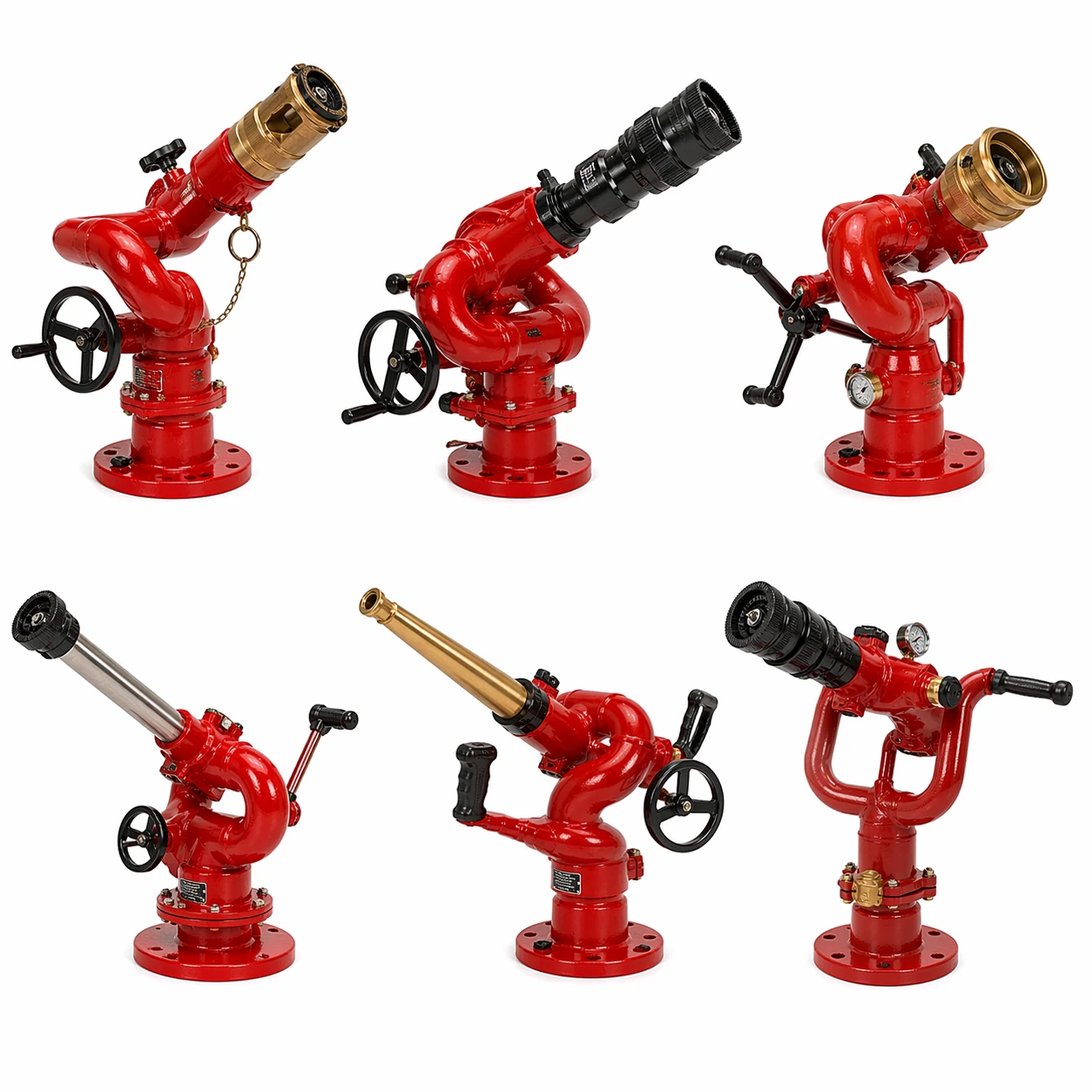
Tank farms, airports and industrial sites. Quoted on flow and throw range rather than bore, so it does not compare against the hydrants above.
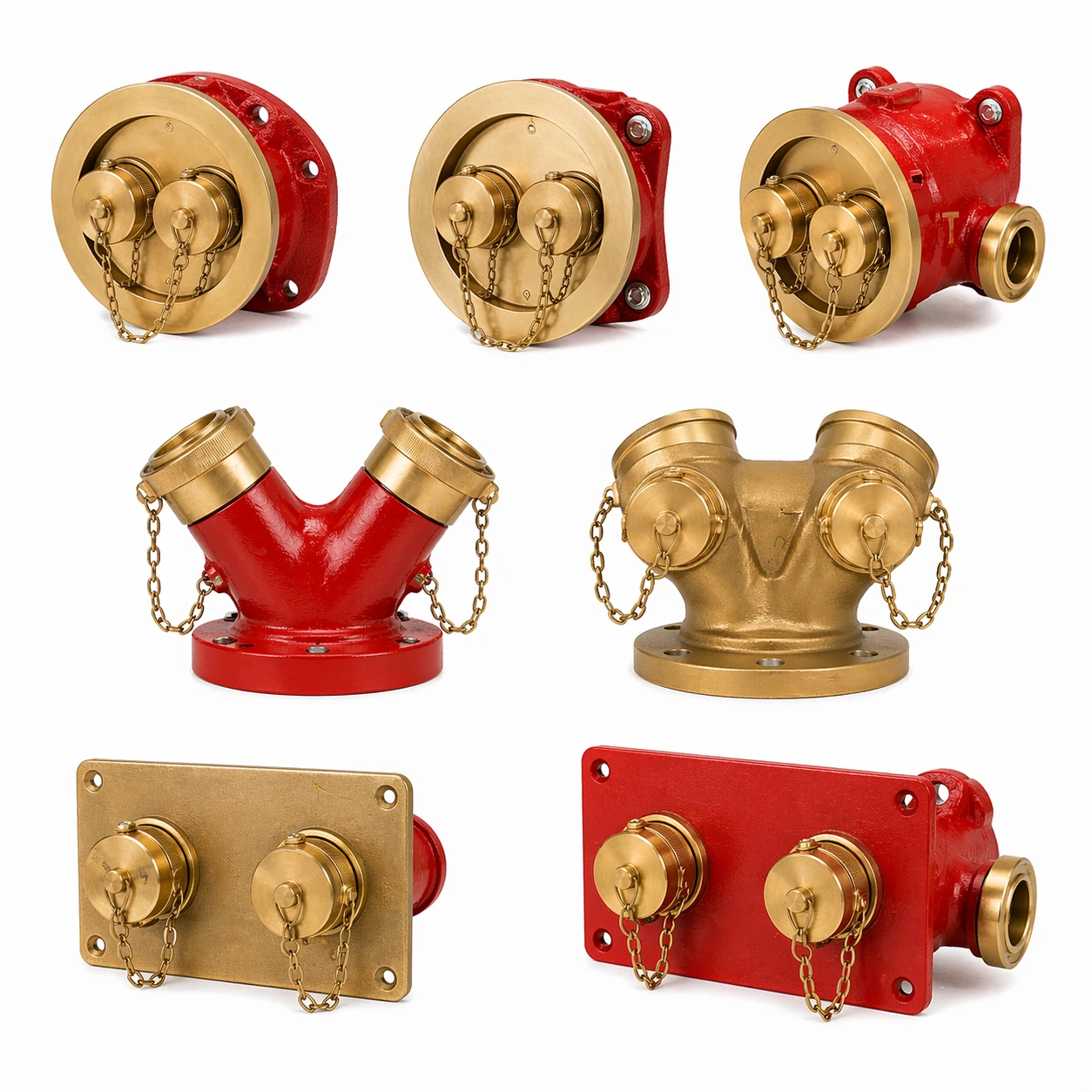
Wall- or pillar-mounted fire department connections. The inlet count and coupling route are set by the attending brigade, not by preference.
Photographs are route illustrations from the catalogue edition and serve as a sourcing reference, not model-level proof. A model-bound sample photo is issued against your confirmed configuration, and a quoted product is always tied to that configuration rather than to the card above.
Monitors are quoted in flow and throw range, so the first row carries two measurement systems rather than pretending a monitor has a nominal bore. Planning MOQ and lead time sit in the same table because those move the schedule.
| Comparison point | Wet barrel | Dry barrel | Wall / box | Landing valve | Monitor | FDC |
|---|---|---|---|---|---|---|
| Size, inlet or flow range | DN80 to DN150 | DN80 to DN150 | DN65 to DN100 | DN65 to DN80 | 500 to 8,000 L/min; 30 to 80 m throw | Dual or triple inlet |
| Working pressure | 1.0 to 1.6 MPa | 1.0 to 1.6 MPa | Up to 1.6 MPa | Up to 1.6 MPa | 0.6 to 1.2 MPa | Up to 1.6 MPa |
| Material | Ductile iron / bronze | Ductile iron / bronze | Ductile iron | Ductile iron / bronze | Stainless steel / aluminium | Ductile iron / bronze |
| Connection or standard | BS 750 / EN 14384 / GB | BS 750 / EN 14384 / GB | GB / EN; gate valve or couplings | BS 5041 / GB; instantaneous | Nozzle and drive by spec | BS336 / Storz |
| Planning MOQ | 200 pcs | 200 pcs | 200 pcs | 200 pcs | 200 pcs | 200 pcs |
| Bulk lead-time reference | 35 to 60 days | 35 to 60 days | 35 to 60 days | 35 to 60 days | 35 to 60 days | 35 to 60 days |
| Inlet connection | Outlet | Catalogue models |
|---|---|---|
| BS4504 flange, φ65 (2″ and 2.5″) | 2.5″ BS336, or 2.5″ BSP | 07-001, 07-003, 07-007, 07-008, 07-010, 07-010A, 07-012 |
| BSP 2.5″ | 2.5″ BS336 | 07-002, 07-002A, 07-004, 07-006, 07-011, 07-019, 07-082A, 07-006CY |
| BSPT 2.5″ | 2.5″ BS336 | 07-002A1, 07-002AV, 07-006FK, 07-009 |
| DN65 | 2.5″ BS336, or 2.5″ BSP with Storz | 07-006GC, 07-002GC-00S |
| JIS 10K, φ65 | 2.5″ BSP | 07-007A |
| ANSI φ65, and ANSI FF 3″ | 2.5″ BSP, or 2.5″ BS336 | 07-007B, 07-082 |
| BSP 2″ | 2″ BSP | 07-002E |
| Inlet | Outlets | Catalogue models |
|---|---|---|
| 100 mm | 2 × 2.5″ BS336 | 14-001, 14-001A |
| 100 mm | 2 × 2.5″ BSP | 14-001E |
| 100 mm | 2 × F2.5″ BSP | 14-001F |
| 100 mm | 2 × φ65 mm | 14-004 |
| 100 mm | 2 × 2.5″ BSP, plus 4″ BSP | 14-006 |
| 100 mm | 2 × DN65, plus DN100 | 14-008, 14-008A |
| 150 mm | 2 × 2.5″ BS336, plus 4″ BSRT | 14-003A |
| 150 mm | 2 × 2.5″ BS336, plus 4″ BSP | 14-007 |
| 2.5″ | 2 × 2.5″ BS336 | 14-012 |
| 2.5″ | 2.5″ BS336 | 14-012A, 14-012D |
| 2.5″ | 2 × 2″ BSP, Storz option | 14-011 |
Values are taken from the May 2026 catalogue edition. Current sale status and manufacturing origin are confirmed during the quotation, together with the exact hydrant pattern, bore, working pressure, outlet or flange standard, and monitor flow. MOQ shown is a planning figure per model, not a contract term.
Destination market decides the document set that ships with the goods. Confirm it with the enquiry so the packing list and declaration are prepared once.
Customization options
Quotes diverge when these two lists are mixed. The left column moves with your order. The right column belongs to the hydrant pattern and cannot be negotiated into a different value.
Each pairing is the check the factory runs it against.
The network decides which route is even eligible. Starting from a part number is how a project ends up with a wet barrel in ground that freezes.
Pillar hydrants on a buried main. Frost depth decides wet against dry; the outlet standard has to match what the local brigade already carries.
Needed to quote: frost condition, bore, outlet standard, quantity.
Landing valves at each floor, with a wall or box hydrant at the entry point. The instantaneous or BS336 connection is what makes it land on the existing riser.
Needed to quote: riser bore, connection standard, floors served.
Monitors sized on flow and throw rather than bore, coordinated with the water supply. Pattern and drive arrangement follow the hazard, not the catalogue.
Needed to quote: required flow, throw distance, mounting and drive.
FDC and Siamese points where the brigade couples in. Inlet count and coupling route are set by the attending service and are not a preference.
Needed to quote: inlet count, coupling route, mounting type.
A hydrant is selected on its outlet designation and a monitor on flow and throw, so two lines of the same order are checked against different inputs. A monitor is quoted as its own route, and the two ship on one order. If you already hold a catalogue number or an OEM part number, send it with the outlet designation your network uses rather than leaving it to be inferred.
| What you are matching | What to send | What the quotation confirms |
|---|---|---|
| Hydrant outlet thread | The designation on the hose the brigade carries, or on the hydrant being replaced (BS336, BSP, BSPT, Storz, JIS, ANSI, or the NST / NH and NPSH designations used in North America) | The outlet standard printed against the quoted model; a combination outside the catalogue is quoted against a drawing |
| Monitor model reference | The catalogue number or OEM part number you hold, with the flow, throw distance and mounting you need | The nearest model in the May 2026 catalogue edition, or a drawing-based quotation where the reference is not listed |
| Monitor drive and nozzle | The nozzle pattern and the drive arrangement the hazard needs | Nozzle and control arrangement, which this page treats as an input the order sets rather than a catalogue value |
| Quantity and schedule | Quantity per model and the date the site needs it | A planning MOQ of 200 pcs per model, samples in 15 to 20 days and bulk production in 35 to 60 days as references |
| Destination document set | The destination market and the certification documents the order has to carry | CCC across current product lines subject to model mapping; CE is not confirmed for hydrants, landing valves, monitors or FDC |
Current sale status and manufacturing origin are confirmed during the quotation together with the exact outlet standard, so a reference sent now is a starting point rather than a confirmed model.
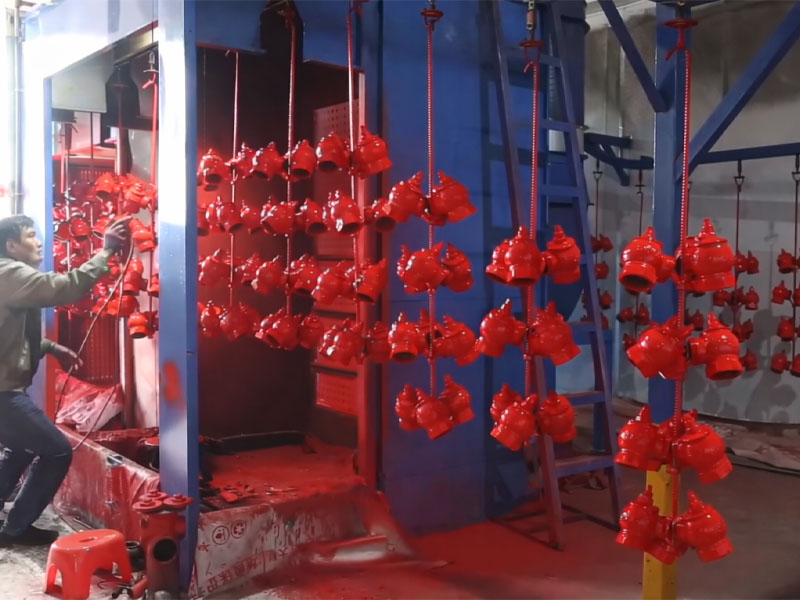
15,000 square metres, 20 production lines, 193 people, and a reference output of 45 high-cube containers a month.

Production floor
One of 20 lines. Shows plant scale and line arrangement. It does not identify a hydrant pattern.

Assembly and inspection
Where incoming, in-process and final checks are carried out. Batch inspection records are issued per order.
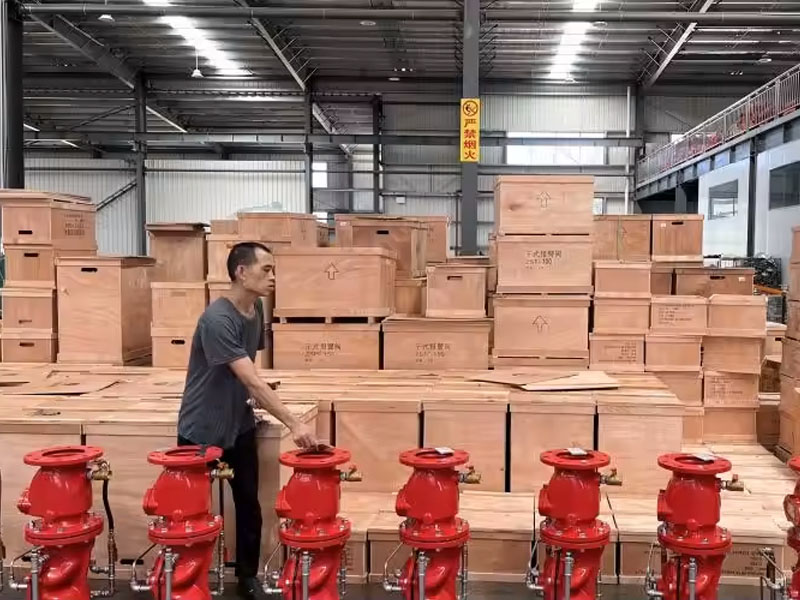
Packing and marking
Carton marking is checked against the order before release. Mixed loading is accepted.
Finished goods storage
General warehouse view across product families. This frame is not a hydrant stock record.
CE does not cover this family. CE is currently confirmed for sprinklers and valves. Hydrants, landing valves, monitors and FDC are outside that scope, and any supplier telling you otherwise should be asked for the certificate holder and the exact model mapping.
CCC can be supported across current product lines, subject to confirming the model mapping for your order.
ISO 9001 is company-level. It is a quality management certificate, not a product certification, and validity is confirmed per order. A declaration of conformity is issued against the confirmed configuration and destination market.
By frost, not by price. A wet barrel stays charged to the outlet and is simpler to maintain. A dry barrel keeps its control valve below frost line and drains after use. In ground that freezes, only the dry barrel survives.
Pillar hydrants run DN80 to DN150 at 1.0 to 1.6 MPa. Wall and box hydrants run DN65 to DN100, landing valves DN65 to DN80, both up to 1.6 MPa. The exact value for a model is confirmed in the quotation.
By flow and throw, not by bore: 500 to 8,000 L/min with a 30 to 80 m reference range at 0.6 to 1.2 MPa. Send the required flow, the throw distance and the mounting and drive arrangement.
BS 750 and EN 14384 references on pillar hydrants, BS 5041 and instantaneous on landing valves, BS336 and Storz routes on FDC. Send the standard already installed rather than the one you would prefer.
No. CE is currently confirmed for sprinklers and valves only. CCC can be supported across current product lines subject to model mapping, and quality management is certified to ISO 9001 at company level.
As a planning figure, 200 pcs per model across hydrants, valves, monitors and FDC. It is a planning number rather than a contract term, and mixed loading across families is accepted.
Samples in 15 to 20 days and bulk production in 35 to 60 days as a planning reference. The schedule is confirmed against the configuration, quantity and document requirement at order confirmation.
The six routes are listed in the May 2026 catalogue edition. Current sale status and manufacturing origin for a specific model are confirmed during the quotation.
Send the drawing with the network type, frost condition and destination market. The specification inputs still missing will be listed back to you before any price is quoted.
Yes. Mixed loading across hydrants, valves and monitors is accepted. Monitor crating is confirmed with the enquiry because handling differs from the hydrant cartons.
The catalogue outlet options are BS336, BSP, BSPT, Storz, JIS and ANSI, listed in the connection tables above. If your hose, or the hydrant being replaced, uses an NST, NH or NPSH designation, send the exact designation and the item it has to couple to. The matching outlet is named with the quotation, and a combination outside the catalogue is quoted against a drawing.
Yes. Send the reference with the flow, throw distance, mounting and drive arrangement you need. It is matched against the May 2026 catalogue edition, and where the number is not listed the quotation is built from your drawing or the reference itself. A model reference does not confirm manufacturing origin or current sale status on its own; both are confirmed during the quotation.
Ten inputs price a quotation. Anything still undecided can be marked open and it will be confirmed before pricing rather than assumed.
Buyer guides
What to fix in the specification, what to ask for on paper, and what to check before packing.
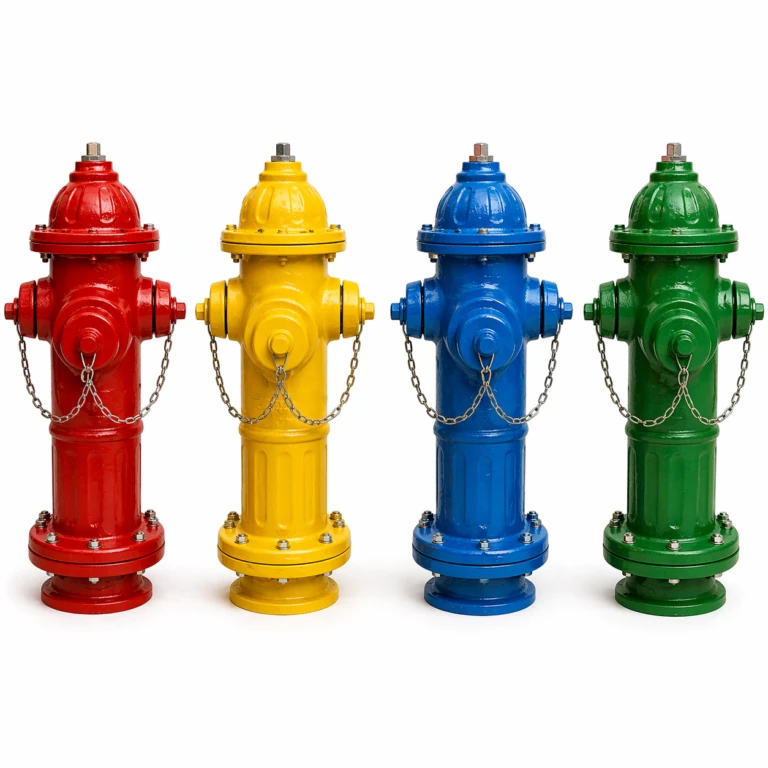
Fire hydrant specification checklist for RFQs: barrel type, bore, pressure rating, and connection details to settle first.
Read guide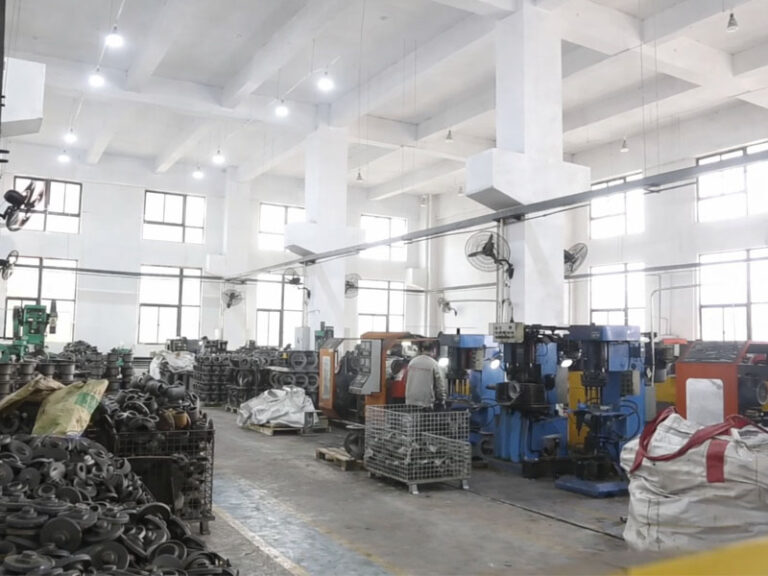
Shortlist Fire Hydrants Certification Document Verification suppliers by sample approval, color tolerance, and QC checks. See which options fit your
Read guide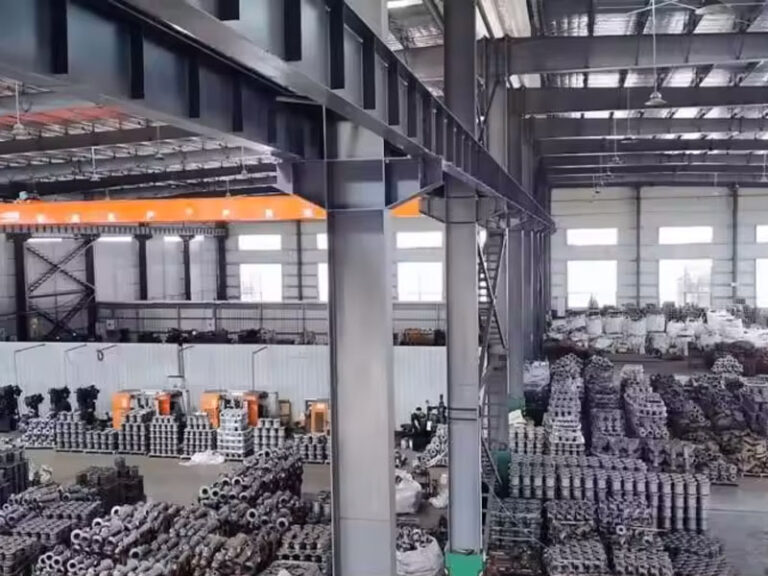
Control bulk fire hydrant QC with checks for model scope, lot records, inspection evidence, carton traceability, deviations, and release ownership.
Read guide