Two fire hose cabinet quotes can carry the same unit price and still differ by a paint changeover, a hinge nobody named, and a valve thread that does not exist in your market.
This guide sets out the drawing, finish and connection evidence to demand from a cabinet factory before a deposit moves, and what each missing document costs on site.
Direct answer: Specify a fire hose cabinet with three written outputs: a dimensioned drawing that states the internal clear width with the reel and cylinder loaded, a finish given as measured film thickness rather than a color name, and a valve thread callout matched to the destination market. Ask for the coating log and the hinge cycle record with the sample rather than after it.
How buyers should verify fire hose cabinet factory proof
Ask for proof in the order a factory can actually produce it: drawing, material record, coating log, then a witnessed door test. A supplier who sends a glossy catalog but stalls on the coating log is telling you something about the shop floor. Read the quality certificate for what it is while you are at it: ISO 9001 is a management-system standard, so its scope statement names the production it covers rather than how a cabinet performs.
| What to confirm | Proof to request | Who issues it | Risk if skipped | Buyer follow-up |
|---|---|---|---|---|
| Body gauge and steel grade | Mill certificate plus a caliper reading on the sample panel | Steel mill, countersigned by the cabinet plant | Thin panels flex and the door drops out of square | Lock the gauge on the drawing before cutting |
| Powder coat film thickness | Coating log with measured thickness from your batch | The plant paint line | Under-cured film chalks in coastal air | Ask for the batch range, not a brochure figure |
| Hinge and latch endurance | Cycle test record for the hardware actually fitted | Plant or its hardware vendor | Latches fail after a year of drills | Name the hinge model in the order |
| Quality system scope | ISO 9001 with the production scope it covers | Certifying body, via the plant | A trader shows a scope that excludes cabinets | Ask which product families the scope lists |
For scale, Fujian Nan’an Minwen Fire Protection Technology Co., Ltd. runs 20 production lines across a 15,000 square metre site in Nan’an, Quanzhou, and ships around 45 high-cube containers a month, which is the context a cabinet quantity sits inside. Minwen Fire holds ISO 9001 and can supply CCC and CE documents on request. Treat any certificate as a starting question rather than an answer: ask which product families it covers before the plant reaches your shortlist.
Which fire hose cabinet red flags should stop supplier approval
Rejected cabinet shipments usually fail for one of three reasons: the box was built for a different mounting condition, the hose and valve inside were never checked against the cabinet opening, or the finish was specified by color instead of by film thickness. All three are visible before a deposit moves, provided the plant states its fit conditions in writing.
| Where it is installed | Fits when | What goes wrong otherwise | Spec or proof to request | Buyer follow-up |
|---|---|---|---|---|
| Indoor recessed, finished corridor | Wall cavity depth is confirmed against cabinet depth | Cabinet stands proud of the wall and the door fouls the trim | Dimensioned installation drawing with tolerances | Approve the drawing before tooling |
| Outdoor or coastal wall mount | Door gasket and base drain are included, finish specified by film thickness | Water sits in the base and rust shows within a season | Coating log and gasket material sheet | Put the film thickness range on the order |
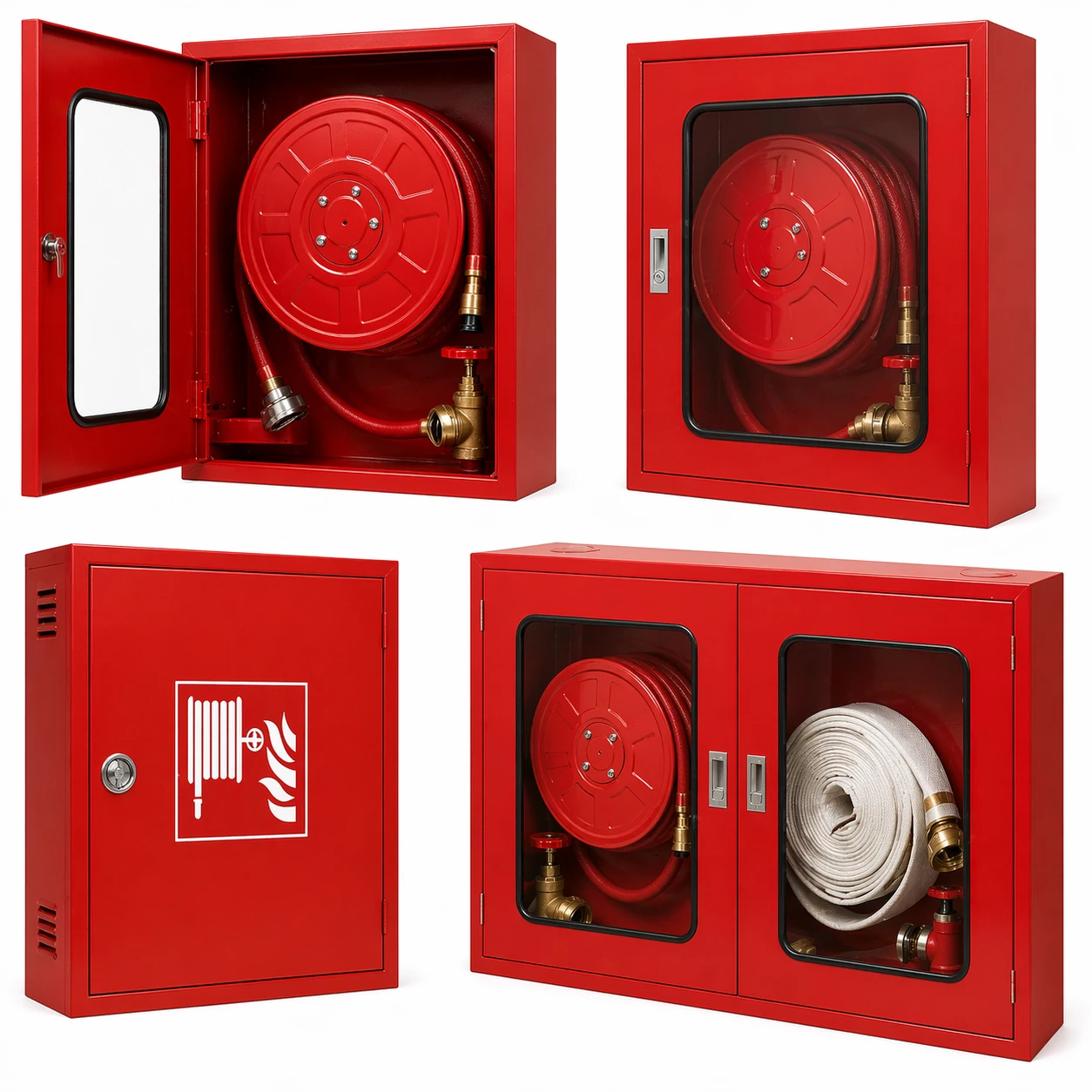
| Combined hose reel and extinguisher | Internal clear width is checked against reel swing and cylinder height | The door will not close on a fully loaded cabinet | Photograph of the loaded sample build | Request that photo before sample sign-off |
| Landing valve inside the cabinet | Valve outlet thread matches local brigade fittings | A thread mismatch makes the cabinet useless on site | Thread callout printed on the valve drawing | Confirm the thread standard per destination |
Judge the box as part of a system rather than as a steel enclosure: the Fire Equipment Manufacturers Association describes fire hose, cabinets and valves as part of a standpipe system, which is why the loaded internal clear width decides more than the outside dimensions do. The thread point catches more buyers than any certificate does. When the cabinet ships with a valve and coupling from the same plant, have the connection detail from the fire hoses reels couplings products repeated on the cabinet drawing so a single document governs both. The real red flag is not a missing document. It is a plant that answers dimensional questions with reassurance instead of a drawing.
RFQ checkpoint
What fire hose cabinet certification scope actually covers
A certificate is a scope document, not a badge. The useful question is never whether a plant is certified, but whether the scope printed on that document includes the cabinet model, the valve fitted inside it, and the market you are shipping to.
| Requirement in your market | Spec to confirm | What goes wrong | Proof or test to request | Buyer follow-up |
|---|---|---|---|---|
| China market approval | CCC coverage for that fire product | Goods marked outside scope are held | CCC document naming the family | Read it before the deposit |
| EU market marking | CE decided model by model | A hose document is read as cabinet compliance | Document title and stated scope | Confirm which models are listed |
| Plant quality system | ISO 9001 held with the production scope listed | Scope excludes the item being bought | Scope text, not the cover page | Match scope wording to your item |
| Component testing | Reports for the hose or valve as fitted | Untested parts pass under the cabinet name | Report on demand, tested configuration | Name it in the order |
A worked example from our own file: the attestation Minwen Fire holds under EN 14540:2014 covers layflat hoses, and the document states it is a voluntary verification that cannot replace an EC Declaration of Performance. Real document, narrow scope, no cabinet coverage.
- Ask which order quantity the scope was assessed against; a certified configuration is tied to the model built at that volume, and re-testing a variant is a cost the quote has to carry.
- Have the regime named per destination on the quotation, so building commercial fire protection solutions never mix two market approvals.
How fire hose cabinet MOQ and lead time affect cost
Cabinet price moves with batch size through tooling and paint-line changeover, not through steel. A press-brake set-up and a color change on the powder line cost the same whether the run is fifty boxes or five hundred, so a small order carries that fixed cost per unit.
The baseline minimum on standard fire protection products at Minwen Fire is 200 pcs, confirmed by configuration, certification requirement, packing and schedule rather than quoted as one flat number. Mixed orders change the arithmetic: three cabinet sizes in one container may clear the minimum in total while each size still triggers its own set-up.
On timing, work backwards from two ranges. A sample runs 15 to 20 days once the specification, certification requirement and branding are settled, and the clock starts at settled rather than at first inquiry. Standard production runs 35 to 60 days after specifications, certification, packing, quantity and schedule are confirmed. Delivery slips for buyers who leave the thread standard or the coating color open, because the plant cannot cut steel until those answers arrive.
- Number of press-brake set-ups and paint changeovers priced into the run.
- Whether the minimum is read per size or across the whole mixed order.
- The event that starts the production clock, stated in writing.
Compare two quotes only after checking that both assume the same set-up count and the same starting point for the clock, because the risk otherwise is a delay charged to the buyer. The Minwen Fire factory page sets out where the in-process checks sit, and that changes the schedule too: an in-line check adds days and removes a rework loop.
What to settle before fire hose cabinet samples or deposit
Two groups of answers decide whether a sample is worth building. Settle both in the quote request and the sample becomes a check on workmanship rather than a second round of specification.
Specifications and connection standards
Fix the outside dimensions, the wall condition the cabinet mounts into, the door swing, and the internal clear width with the reel or extinguisher actually loaded. Then fix the connection: valve outlet thread, coupling type, and whether the plant or a third party supplies them. A cabinet drawing that leaves the thread as to be advised is not a drawing. Our Minwen Fire product catalog is a starting reference, but the order should carry your own dimensioned sheet.
Marking requirements and inspection terms
Decide what is printed or applied on the door, in which language, and to which local labeling rule, before the first sample is painted. Set the inspection terms in the same message: who inspects, against which drawing revision, what counts as a defect, and what happens to a rejected batch. Buyers who leave inspection terms until shipment are negotiating from the weakest position they will ever hold.
In conclusion
A fire hose cabinet decision comes down to three written outputs: a dimensioned drawing that includes the loaded internal clear width, a finish specification stated as film thickness rather than color, and a connection callout that matches the destination market. Everything else in a supplier conversation is commentary on those three.
Take the checks above into the quote request in that order. Ask for the coating log and the hinge cycle record with the sample rather than after it, and confirm which product families each certificate covers before the plant reaches your shortlist. Skip that sequence and the risk is a batch rejected on site for a thread mismatch or a coating defect nobody measured. Where a valve or reel ships inside the cabinet, keep one drawing governing both so the standard cannot drift.
When the specification is settled, the fire cabinets accessories products is the right page to quote against, because it carries the configurations and the accessory fitments the drawing has to reference. Send that page your dimensioned sheet, the destination market, and the quantity split by size, and the reply will be a quotable specification instead of a price guess.
Fire hose cabinet FAQ
Which quote terms should buyers compare before RFQ?
Compare the set-up count, the coating specification, the thread callout, and the packing method. Two quotes with the same unit price often differ by one paint changeover and a different carton, which is where the money actually moves.
What should buyers verify before approving fire hose cabinet?
Verify the loaded internal clear width, the measured coating thickness on your batch, and that the door closes and latches with the reel and cylinder in place. Photographs of the loaded sample settle most of this in one exchange.
Which sample or QC proof should buyers request?
Request the coating log for the sample batch, the hinge and latch cycle record for the hardware fitted, and a dimensioned photograph against the approved drawing revision. Test reports for the hose or valve fitted inside can be supplied on demand.
What Are Your Primary Fire Risks?
That answer drives the cabinet, not the other way round. A coastal plant room needs a gasketed and drained outdoor box; a finished hotel corridor needs a recessed unit with a trim tolerance. Name the installation environment first and the specification narrows quickly.
RFQ handoff: Send Specs for Review.