Foam systems are quoted as equipment and fail as interfaces. The concentrate, the proportioner, the tank, and the discharge device each price cleanly on their own; what goes unstated is whether they work together at the flow and pressure the hazard needs.
This checklist puts the interface first — concentrate type, proportioning method, tank material, discharge device — and lists the evidence to request against each before any of it is priced.
Direct answer: Confirm foam concentrate type, proportioning method, tank material, and discharge device model as one interface before requesting prices. Quoting the four separately is how a compatible-looking package arrives that cannot hold its proportioning rate.
Set the procurement decision and approval boundary
Compare this checkpoint against one quote request revision. Each row should identify the requirement, approval evidence, and buyer action before production.
| Requirement | Factory control | Evidence to verify | Order risk | RFQ follow-up |
|---|---|---|---|---|
| Sample approval | Pre-production sample reviewed against specification parameters. | Compare dimensions, material, finish to approved data sheet. | Production delay if sample fails inspection. | Request sample approval before production order. |
| Material / substrate | Incoming material certificate verified per RFQ spec. | Cross-check mill certificate with chemical composition. | Non-conforming material leads to corrosion or failure. | Request material certificate with quotation. |
| Width or size tolerance | Dimensional inspection at defined production intervals. | Measure with calibrated gauge; record deviation. | Oversized or undersized parts cause installation issues. | Verify tolerance range in RFQ specification. |
| Finish or color control | Visual inspection under standard lighting against approved sample. | Use color spectrophotometer or visual comparison. | Color mismatch leads to rejection on site. | Approve color sample before bulk coating. |
| Packing format | Packaging method documented and inspected prior to shipment. | Check packing list, pallet dimensions, and labeling. | Incorrect packing causes damage or customs delay. | Confirm packing details in RFQ final review. |
For foam suppression system, use Set the procurement and approval boundary as the decision scope. Read the rows as one approval sequence. Start with sample approval; use the risk and buyer-action columns to decide whether its evidence is sufficient. Verify it with the inspection method and approval evidence recorded in the table.
For this foam suppression system sourcing record, keep the supplier response, marked sample, and approval owner under the same revision number. If any proof conflicts with the approved record, hold the quote, sample, or production release until the supplier explains the deviation in writing. Before closing the checkpoint, reconcile the latest drawing, sample, quotation, and approval comments, identify which record controls if they disagree, and document the resolution. Carry the signed Set the procurement and approval boundary table into the purchase order and production handoff so the same checks support quote comparison, sample approval, shipment release, and later reorders.
Confirm buyer-owned specifications before supplier review
- Supplier cannot confirm foam concentrate type and proportioning method: Mismatched concentrate or ratio causes system failure during discharge, voiding warranty and risking asset loss. Request the supplier's specification sheet for the proposed concentrate and proportioner model. Manufacturer data sheet listing concentrate brand, percentage, and compatible proportioning equipment. Compare the data sheet against your project's fire hazard analysis and approved design basis.
- No documented test report for the proposed foam concentrate batch: Untested concentrate may not meet expansion ratio, drainage time, or extinguishment performance required by the quote request. Ask for the batch-specific test certificate from the concentrate manufacturer. Third-party or manufacturer test report showing expansion ratio, drainage time, and extinguishment test results. Verify the test report date matches the batch number and that values meet your specification limits.
- Supplier cannot provide a written approval gate for sample sign-off before production: Without a formal sample approval step, production may proceed with unverified dimensions, materials, or labeling. Require a written sample approval procedure as part of the purchase order terms. Supplier's sample approval checklist or a signed statement confirming sample review and sign-off before bulk production. Include the sample approval gate in the quote request response evaluation criteria and purchase order.
- Supplier's quoted lead time does not account for certification document delivery: Missing CCC, CE, or UL test reports can delay customs clearance and project handover. Ask the supplier to confirm that all required certification documents will be shipped with the equipment or provided before shipment. A written commitment listing each required certificate and its delivery timeline relative to shipment. Cross-check the commitment against your project's certification requirements and customs clearance checklist.
- Does the supplier have documented capability to produce the specified foam concentrate type and proportioning method? Verifies that the factory's equipment and process experience match the exact foam suppression system design before committing to a quote. Supplier provides a capability statement listing the specific concentrate, inductor, and bladder tank models they have produced. A mismatch in concentrate type or proportioning method can cause system failure, void warranties, and delay project approval. Request a written capability summary and cross-reference it with the quote request specification sheet.
- What quality control checks are performed on the foam concentrate batch before shipment? Ensures the concentrate meets the specified expansion ratio, drain time, and corrosion resistance without relying on generic claims. Supplier shares a standard QC checklist that includes viscosity, pH, and expansion ratio tests for each batch. Unchecked concentrate can fail during commissioning, leading to costly rework and project delays. Ask for a sample batch test report or arrange a third-party lab test before bulk production.
- How will the buyer verify that the delivered foam suppression system equipment matches the approved sample? Prevents acceptance of non-conforming units that could compromise system performance and insurance coverage. Supplier agrees to a documented inspection at the factory or a third-party inspection before shipment. Without a verification method, the buyer may receive equipment that deviates from the approved specification. Include a clause in the purchase order requiring pre-shipment inspection and photo evidence.
- What is the buyer's follow-up process if the foam concentrate or hardware fails the incoming inspection? Establishes a clear corrective action path to avoid project delays and financial loss. Supplier provides a written return and replacement policy with a defined turnaround time. No defined process can lead to disputes, extended downtime, and unplanned costs. Document the agreed-upon corrective action steps in the purchase order or contract.
- Are the foam concentrate and hardware specifications locked before the supplier begins production? Prevents scope creep and ensures the quote, sample, and bulk run are based on the same approved inputs. Both parties sign a specification sheet that includes concentrate type, tank size, pipe material, and flow rate. Unlocked specs can lead to cost overruns, rework, and non-compliant equipment. Create a final specification document and obtain written confirmation from the supplier before production.
Required product, project, artwork, packing, and quantity inputs
Before sending the quote request, confirm the foam concentrate type, proportioning method, tank material, and discharge device model. Include the project's industrial high hazard suppression solutions classification, ambient temperature range, and any special coating or labeling requirements. Specify artwork approval for nameplates and instruction labels. Define packing method, pallet type, and quantity per shipment. These inputs prevent rework and keep quotes comparable.
Items that must remain quote- or approval-dependent
Keep the final foam concentrate brand, batch number, and test report as quote-dependent items rather than fixed specifications. The proportioning valve size, tank capacity, and discharge device orifice must remain subject to sample approval. Packing details such as crate type, desiccant use, and labeling language should be confirmed after the sample is signed off. This preserves flexibility without delaying the quote request.
quote request checkpoint
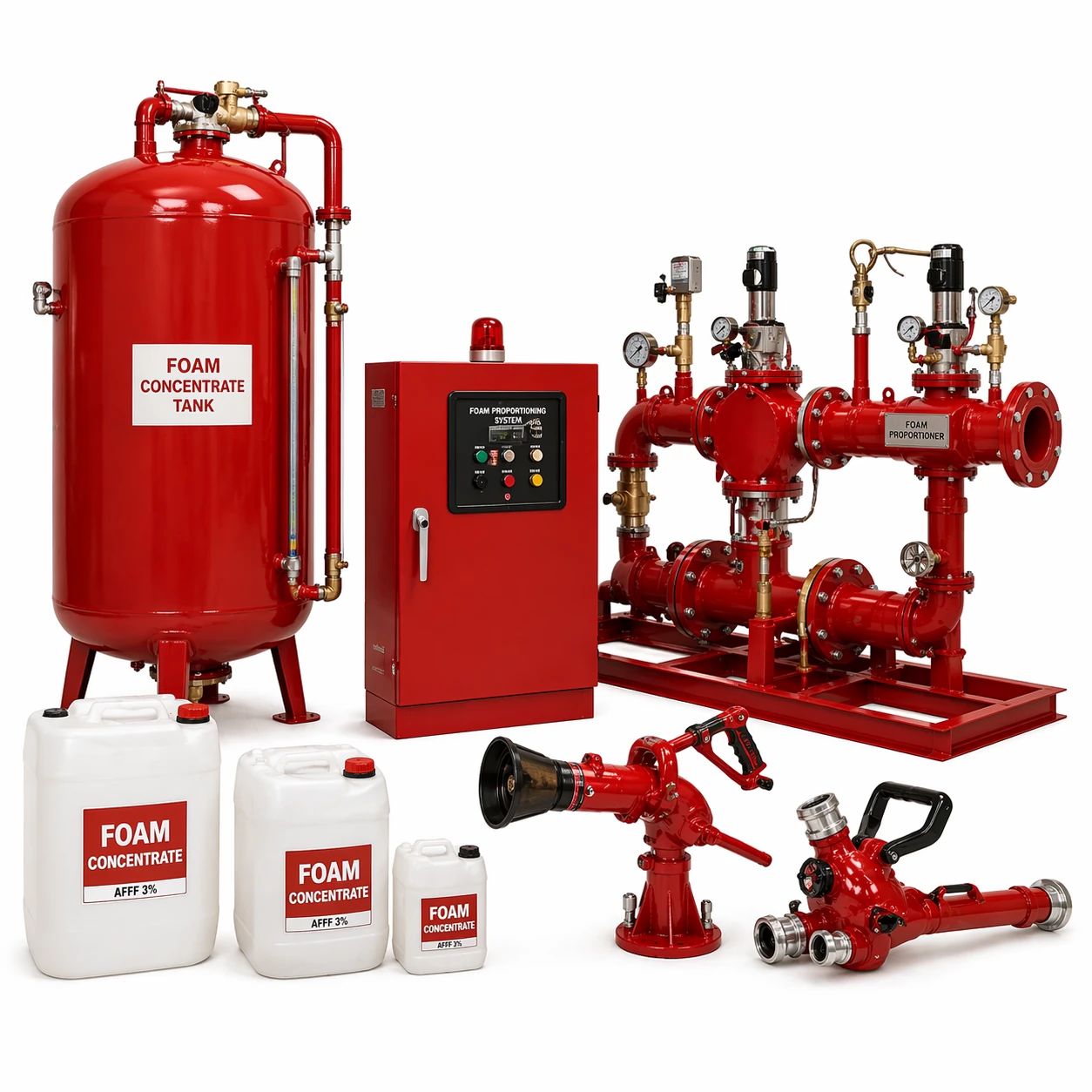
Build the foam-system interface matrix
| Cost driver | What changes it | Quote signal | Risk to avoid | Buyer action |
|---|---|---|---|---|
| Foam concentrate type and proportioning method | Bladder tank, balanced-pressure, or inline inductor choice alters pump and tank costs | Supplier lists separate line items for concentrate, tank, and proportioner | Bundled pricing hides expensive proprietary concentrate or undersized tank | Request itemized cost for each subsystem; verify concentrate compatibility with your hazard classification |
| Minimum order quantity for foam concentrate | Standard 200 L drums versus custom IBC tote or bulk delivery | MOQ stated in liters or drums with per-unit price break at higher volume | Over-ordering concentrate that exceeds shelf life or under-ordering that triggers reorder premium | Confirm concentrate MOQ against annual consumption estimate; request shelf-life guarantee in writing |
| Lead time for bladder tank assembly | 35–60 day production versus 15–20 day sample schedule | Lead-time quote includes condition: after specification, certification, and packaging confirmation | Unconfirmed certification documents delay production start and push delivery past project deadline | Submit CCC or CE document requests at RFQ stage; lock production schedule only after document approval |
| Quality control documentation package | Basic COA versus full test report with batch traceability | Supplier offers UL test reports on demand and ISO 9001 QMS certificate | Missing test reports force re-inspection at arrival, adding cost and project delay | Specify required QC documents in RFQ; request sample of test report format before order |
| Buyer follow-up for specification exceptions | Approved deviation memo versus verbal concession that disappears at inspection | Supplier documents each exception with owner name, date, and approval status | Unrecorded exceptions become non-conformance claims during final inspection or handover | Maintain a written exception log with owner sign-off; attach to purchase order as amendment |
For foam concentrate type and proportioning method, a poor decision can mean bundled pricing hides expensive proprietary concentrate or undersized tank. Request written proof and compare it with the approved sample or specification.
For products, preserve the foam concentrate type and proportioning method decision under one revision number: keep the supplier response, marked sample, approved specification, quotation, and approval owner together. If the evidence conflicts with the approved record, hold the quote, sample, or production release until the deviation is explained in writing. Once the buyer and designated technical authority have accepted the evidence, carry the signed Build the foam-system interface matrix record into the purchase order, production handoff, shipment release, and later reorder review so every team works from the same baseline.
Compare options and record open assumptions
When comparing bladder tank and balanced-pressure systems, document every assumption about concentrate type, tank volume, and proportioning ratio. An unrecorded assumption about water supply pressure or foam concentrate viscosity can make the selected system non-functional at commissioning. Use the cost breakdown table to capture each variable before requesting quotes.
Name the owner and status of every exception
Each specification exception—whether a substitute concentrate, alternative tank material, or modified outlet size—must have a named owner and a status of approved, pending, or rejected. Without this record, the procurement team cannot distinguish between a deliberate design change and an unapproved substitution. Attach the exception log to the purchase order for audit trail.
Request supplier evidence without assuming capability
Only request a foam concentrate sample after the supplier confirms your specified expansion ratio and proportioning rate in writing. Without this confirmation, the sample may not match your about us design, wasting time and testing budget.
Sample, document, and production-record requests
Ask for a material safety data sheet (MSDS) and a certificate of analysis (CoA) for each concentrate batch. Require a production record showing the batch number, fill date, and test results for viscosity, pH, and sediment. If the supplier cannot provide these, the foam may degrade during storage or fail under discharge conditions.
For factory execution, request a written statement of the minimum order quantity (MOQ) and the lead time for sample production. Verify that the supplier can produce a sample that matches your quote request specifications before committing to a full order. This step reduces production risk by confirming the supplier’s ability to replicate the specified foam properties.
Use the table below to track required evidence during quote request handoff:
| Evidence Type | Requirement | Buyer Verification Question |
|---|---|---|
| Foam concentrate sample | Must match specified expansion ratio and proportioning rate | Does the sample CoA confirm these parameters? |
| MSDS | Provided for each batch | Is the MSDS current and complete? |
| Production record | Batch number, fill date, viscosity, pH, sediment test results | Are all test values within your specified limits? |
| MOQ and lead time statement | Written confirmation for sample and production | Does the MOQ align with your project volume? |
After collecting these documents, cross-check the sample test results against your system design parameters. If any discrepancy appears, request a revised sample before proceeding to production.
Review quote or sample evidence before approval
Build the foam suppression system quote request around Foam concentrate specification sheet. Match every listed buyer input to written supplier confirmation, approval evidence, and the risk that would hold the quote.
- Foam concentrate specification sheet: Confirms the exact percentage, type, and manufacturer before production begins. Compare the quoted AFFF against the project's approved specification. Wrong concentrate can fail suppression tests and delay approval. Request the supplier's data sheet and cross-check with the quote request requirement.
- Minimum order quantity for foam concentrate: MOQ affects total cost and whether partial drums are acceptable. Verify if the MOQ is per drum or per pallet for the quoted concentrate. Ordering below MOQ may trigger a price adder or order rejection. Confirm the minimum order in writing and check if mixed products can fill the minimum.
- Production lead time for foam suppression system equipment: Lead time determines project scheduling and potential expedite fees. Compare the quoted 35–60 days against the project's delivery window. Late delivery can halt installation and incur penalty clauses. Document the confirmed lead time and request a production schedule.
- Cost driver breakdown for foam system components: Identifies which part of the quote drives the price—concentrate, tank, or trim. Ask the supplier to separate material cost from certification and packaging fees. Hidden cost drivers can inflate the final invoice without justification. Request a line-item cost breakdown and compare against catalog products.
- Quality control evidence for foam concentrate batch: Verifies the batch meets the specified viscosity, expansion ratio, and drain time. Review the supplier's test report for the concentrate lot number quoted. Unverified batch quality can cause system failure during commissioning. Request a certificate of analysis for the specific batch before approval.
Acceptance points and unresolved risks
Before approving the quote, confirm that the supplier's sample matches the approved specification and that the catalog products listed in the quote are the exact models tested. Any deviation in concentrate type, system pressure, or component certification must be documented as an unresolved risk. The buyer should flag these items for resolution before issuing a purchase order.
Freeze changes for bulk production or repeat orders
For foam suppression system, this section converts freeze changes for bulk production or repeat orders into quote request inputs, supplier evidence, approval risk checks, and the next sample or quote decision.
Version, sample, SKU, and packing change control
Without a frozen specification, bulk production carries the risk of rework, rejected batches, and cost overruns that the buyer absorbs. A single unapproved change—whether in foam concentrate viscosity, discharge nozzle geometry, or packing material—can shift the system’s expansion ratio outside the acceptance band, making the entire order non-compliant. To prevent this, the quote request must require the supplier to confirm each parameter on a shared change control matrix before any repeat order is released. For example, the buyer should verify: Is the foam concentrate batch number identical to the approved sample? Has the SKU for the discharge device been revised? Are packing dimensions and pallet configuration locked? The table below outlines the minimum checkpoints for freezing changes.
| Parameter | Buyer verification question |
|---|---|
| Foam concentrate type & concentration | Does the concentrate batch match the RFQ-approved sample certificate? |
| Discharge device SKU & orifice size | Is the SKU unchanged from the sample order? |
| Packing specification | Are carton dimensions, inner dividers, and pallet pattern identical to the approved packing record? |
| Production version | Has the supplier issued a version number that matches the last approved sample? |
Once the buyer confirms each line, the supplier must issue a signed change control notice that freezes all variables. This document becomes the binding reference for bulk production. Any subsequent deviation—even a minor packing change—must trigger a new sample approval cycle. By enforcing this handoff, the buyer eliminates ambiguity, reduces inspection time, and ensures that repeat orders replicate the exact performance of the original sample.
Prepare a comparable RFQ and handoff record
At this stage, the buyer must have a completed foam-foam suppression systems products interface matrix that lists all buyer-owned specifications—discharge rate, concentrate type, expansion ratio, and material compatibility—before the supplier can confirm the quote request. The output required before the next stage is a signed handoff record that documents both the quote request package and the sample acceptance criteria.
Buyer inputs to send to the supplier
- Confirm the foam concentrate specification (e.g., AFFF, FFFP, or alcohol-resistant type) and the required expansion ratio (low, medium, or high).
- State the discharge rate per nozzle and the total system flow demand in liters per minute or gallons per minute.
- Provide the operating pressure range and the maximum allowable pressure drop across the foam proportioner.
- Specify the material of construction for all wetted parts (e.g., stainless steel, brass, or polypropylene) and the required corrosion resistance standard.
- Define the acceptance test criteria for the sample unit, including the test duration, foam quality measurement, and the number of test cycles.
Use the table below to capture cost or minimum order requirements and production risk factors. This table must be completed and attached to the handoff record.
| Parameter | Buyer Verification Question | Supplier Response |
|---|---|---|
| Cost per unit | What is the unit price for the specified foam proportioner and nozzle set? | |
| Minimum order quantity | What is the minimum quantity per order for the selected foam system components? | |
| Production risk | What is the longest lead-time component in the system, and what is its current availability? | |
| Factory execution | Does the factory have a documented quality plan for foam system assembly and hydrostatic testing? | |
| RFQ/sample handoff | When will the sample unit be shipped, and what documentation will accompany it? |
After the supplier completes the table, review the responses against the interface matrix. If any discrepancy exists, request a revised quotation before proceeding to sample evaluation. The handoff record must include the signed table and the original quote request document.
Buyer questions about foam suppression system equipment RFQ
Before the supplier can issue a quotation, the buyer must confirm the foam concentrate type, discharge rate, and expansion ratio. A completed foam-system interface matrix listing all buyer-owned specifications—such as pipe material, ambient temperature range, and water supply pressure—serves as the verifiable evidence that the quote request is ready for review. Without this matrix, the supplier cannot confirm system compatibility or provide accurate pricing.
What must be confirmed before quotation?
The buyer should verify the following items with the supplier before requesting a formal quote:
- Foam concentrate type (e.g., AFFF, FFFP, or alcohol-resistant) and its compatibility with the system materials.
- Design discharge rate and required expansion ratio for the protected hazard.
- Water supply pressure and flow rate available at the system inlet.
- Ambient temperature range and any freeze protection requirements.
- Pipe material and diameter specifications for the foam solution piping.
What evidence belongs in sample approval?
During sample approval, the buyer must provide documented evidence that the foam suppression system meets the agreed specifications. This includes:
- Test reports from an accredited laboratory confirming discharge rate and expansion ratio.
- Material certificates for all wetted components, verifying corrosion resistance and compatibility with the foam concentrate.
- A signed interface matrix that cross-references each buyer-owned specification with the supplier’s confirmed values.
The following table summarizes the key decision points during the quote request and sample handoff:
| Stage | Buyer Action | Supplier Confirmation |
|---|---|---|
| RFQ submission | Provide completed interface matrix | Confirm all buyer-owned specs |
| Quotation review | Verify discharge rate, expansion ratio, and material compatibility | Issue cost breakdown with MOQ and lead time |
| Sample approval | Submit test reports and material certificates | Sign off on sample compliance |
By following this checklist, the buyer ensures that the foam suppression system equipment quote request is complete and that sample evidence supports a smooth transition to production.
Conclusion and next procurement action
With the foam suppression system quote request structured around verified concentrate specifications, discharge rates, and tank sizing, the buyer can now shortlist suppliers who provide documented proof of each claimed parameter. Before approving a sample, compare the quoted cost and lead time against the baseline minimum order and production schedule, and request the applicable CCC or CE documents on demand to confirm category-level coverage. This approach ensures that every procurement decision—from specification validation to supplier selection—rests on verifiable evidence rather than assumptions, reducing the risk of non-compliant equipment arriving on site.
To request a quote for this order, use foam suppression systems products to confirm the final specification, quote assumptions, sample approval, QC evidence, approval risk, and supplier follow-up before bulk order.
Foam suppression system equipment rfq FAQ
What should a buyer confirm for foam suppression system equipment rfq?
Only if the buyer first documents the foam concentrate specification, system design parameters, and required certifications. The buyer should then check the supplier’s capability to meet those specs, request a cost breakdown tied to the confirmed minimum order, and ask for the lead time based on the production schedule. Supplier risk is reduced by verifying that the supplier can provide sample approval evidence and that the quote request includes a clause for sample follow-up before bulk production.
What evidence should a supplier provide for foam suppression system equipment rfq?
The supplier should provide documented evidence that the foam suppression system equipment meets the buyer’s specification, including test reports or certification documents such as CCC or CE coverage for the product family. The buyer should also request a sample for QC verification, confirm the minimum order and lead time in writing, and ensure the supplier includes a clear cost breakdown. Supplier risk is mitigated by checking that the supplier can deliver on the agreed schedule and by arranging a sample follow-up to validate performance before committing to bulk production.
How should changes be recorded before production or reorder?
Changes should be recorded by documenting the revised specification, cost impact, and any adjustments to minimum order or lead time in a formal change order. The buyer reviews that the supplier approves the changes in writing and that sample approval is repeated if the change affects performance. Supplier risk increases if changes are not tracked, so the buyer checks that the updated quote request includes a clause for sample follow-up and QC verification before reorder or bulk production.
So what exactly is a foam system?
A foam system is a fire suppression solution that uses foam concentrate mixed with water to extinguish flammable liquid fires. For B2B sourcing, the buyer records the foam concentrate specification, system type, and required certifications with the supplier. The buyer should also check the minimum order and lead time, request a sample for QC verification, and arrange a sample follow-up to ensure the system meets project requirements before placing a bulk order.
What should buyers verify before approving foam suppression system equipment rfq?
Buyers review that the foam suppression system equipment specification matches the project requirements, that the supplier can provide certification evidence such as CCC or CE, and that the minimum order and lead time are acceptable. The buyer should also check the supplier’s risk by reviewing their quality management system, request a sample for QC verification, and ensure the quote request includes a sample follow-up step. Supplier risk is further reduced by confirming that the supplier has experience with similar systems and can deliver on the agreed schedule.
quote request handoff: Send Specs for Review.
Source check: ISO 2859-1 sampling inspection standard; EVA Foam Supplier Guide for B2B Buyers and Custom Projects; quote request Process Explained: Steps, Examples, and Best Practices.