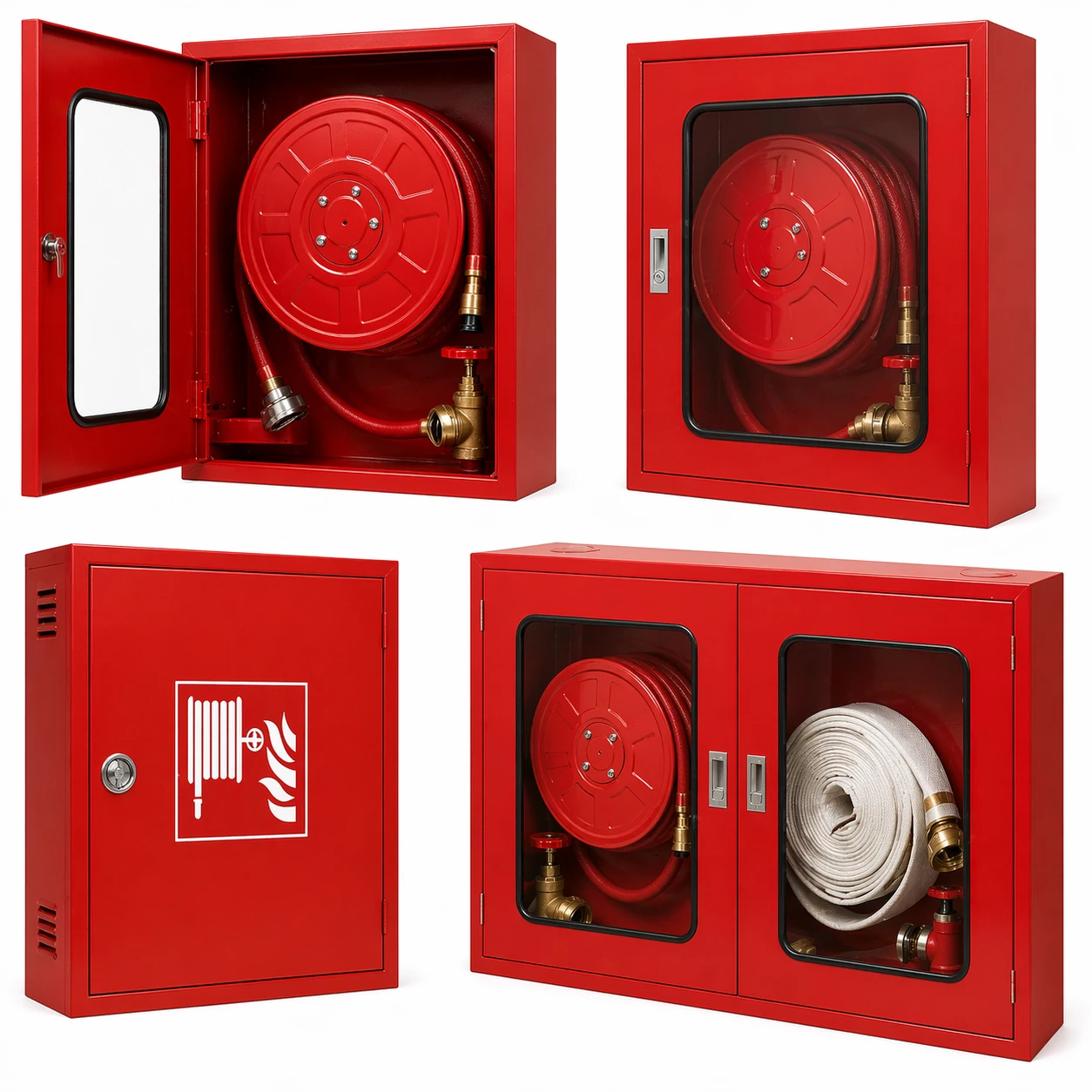
Cabinet approval fails on the opening more often than on the cabinet. The wall aperture, the door swing, the installed envelope of the hose reel or extinguisher inside, and the clearance to remove it are four separate dimensions, and a sample approved without all four will not install.
This checklist works from the opening outward — equipment fit, door and glazing construction, lock and access operation, then finish and workmanship on the sample.
Direct answer: Approve a fire cabinet against the wall opening and the installed envelope of the equipment it houses, including door-swing and removal clearance, before judging door construction, glazing, lock operation, or finish.
Define the Fire Cabinet Equipment and Opening Size
| Requirement | Factory control | Evidence to verify | Order risk | RFQ follow-up |
|---|---|---|---|---|
| Width or size tolerance | Factory uses calibrated templates for each cabinet model. | Measure opening width at three points; compare to approved drawing the buyer-approved tolerance. | Oversized gaps compromise fire rating; undersized prevents equipment fit. | Request factory's tolerance report with first-sample submission. |
| Finish or surface effect | Factory applies coating per approved RAL or texture chip under controlled humidity. | Visually compare sample to approved master chip under buyer-approved viewing conditions; check gloss meter reading. | Off-spec finish causes rework or rejection at site inspection. | Approve finish only after signed-off color card and gloss range are documented. |
| Artwork or logo file | Factory uses vector file for silk-screen or pad-print registration. | Verify logo placement, size, and color against approved artwork PDF on first article. | Misaligned or faded logo leads to branding non-compliance and reorder costs. | Shortlist supplier only after artwork proof is signed and filed. |
| Sample approval | Factory holds sample until written sign-off is issued. | Inspect door glazing, lock function, finish, and dimensions per checklist; photograph each. | Unapproved sample triggers production hold or shipment rejection. | Approve sample in writing; confirm MOQ and lead time before production release. |
Confirm housed equipment access and wall condition
Before ordering, verify that the wall opening can accommodate the cabinet dimensions plus clearance for door swing and equipment removal. Check for obstructions such as conduits, pipes, or uneven surfaces that could prevent flush mounting. A site survey ensures the cabinet fits without field modifications that void certification.
Set handedness mounting and clearance requirements
Specify door hinge side and swing direction to match egress path and user reach. Confirm clearance for lock operation and glazing visibility from the approach angle. Document these requirements in the RFQ so the factory builds the correct handed version, avoiding costly field reversals or reorders.
Verify Door Frame and Glazing Construction
- 1. Compare frame dimensions to approved shop drawing: Approved shop drawing with door opening width, height, and depth Actual frame dimensions recorded on a calibrated tape measure Oversized or undersized frame delays installation and may void fire rating Sign off on dimension report or reject with marked deviation
- 2. Verify material thickness and edge protection: Specified steel gauge and edge trim type (e.g., KD, welded) Gauge reading from micrometer and edge profile photo Thinner steel reduces structural integrity and door-closing durability Request supplier's gauge calibration certificate if reading is borderline
- 3. Inspect glazing opening angle and viewing area: Required viewing angle and clear opening dimensions Glazing bead fit and hinge swing clearance measurement Restricted view or binding glass can cause field rework and safety hazard Document pass/fail and photograph the glazing gap tolerance
- 4. Check lock and finish sample against approved mock-up: Approved finish color chip and lock model number Lock function test result and finish texture comparison under standard light Mismatched finish or lock failure leads to rejection at final inspection Approve sample or issue corrective action request with photo evidence
- 5. Confirm lead time for production sample: Required sample delivery date and quantity Written lead-time commitment (15–20 days after all specs confirmed) Uncommitted schedule risks project delay and missed installation window Freeze sample timeline in purchase order or escalate to expedite
Check dimensions material thickness and edge protection
Start by comparing the frame's width, height, and depth to the approved shop drawing. Use a calibrated tape measure at three points per side. Thinner steel than specified reduces fire resistance and door-closing durability. Edge building commercial fire protection solutions route—welded or knock-down—must match the wall type. A deviation here means rework or a failed fire test.
Inspect opening angle alignment and viewing requirements
Test the door swing to ensure the glazing opening angle meets the specification. Measure the clear viewing area and check that the glass bead seats without binding. A restricted view or misaligned hinge can cause field rework and safety issues. Document the gap tolerance with a photo and sign off only when the angle matches the approved mock-up.
RFQ checkpoint
Review Fire Cabinets Accessories Products Specification Page
Check Lock Latch and Access Operation
- Lock latch operation under fire-rated conditions: Latch failure during fire test invalidates cabinet approval and may require full retest QC manager and project engineer Cycle lock 50 times; confirm latch engages within the buyer-approved tolerance with door closed Document cycle count and pass/fail result; attach video evidence to approval record
- Emergency access feature (break-glass or key override): Non-compliant emergency release voids fire sprinklers alarm valves products product route listing for the assembly Fire safety officer or third-party inspector Test emergency release with gloved hand; measure force required to activate Record activation force in Newtons; compare to specified maximum per project spec
- Door glazing integrity after latch test: Cracked or dislodged glazing after latch cycling requires new sample build and delays lead time by 15–20 days QC inspector and buyer's representative Inspect glazing gasket seal and glass edge for chips or movement after 50 latch cycles Photograph glazing condition; sign off only if no visible damage or seal displacement
- Hardware model and replacement parts record: Unlisted lock or handle model creates spare-part sourcing risk and may delay field maintenance Procurement manager and supplier's hardware engineer Cross-reference lock, handle, and key model numbers against approved sub-supplier list Freeze hardware BOM revision; request supplier to provide replacement-part lead time in writing
Test keys handles and emergency access features
Before approving the sample, verify that the key turns smoothly in both normal and emergency modes. A stiff or misaligned key can fail under fire conditions, causing the door to jam. Test the emergency release mechanism with the door closed to confirm it activates without excessive force. Document any resistance or binding.
Record hardware model and replacement needs
Note the exact brand, model, and serial number of the lock, handle, and emergency release. This record ensures you can order replacement parts without disassembling the cabinet later. Ask the supplier for the lead time and MOQ for each hardware component. Attach the hardware data sheet to the approval file for future reference.
Approve Finish Markings and Workmanship
For fire cabinets door, this section connects approve Finish Markings and Workmanship with artwork files, material choice, finish proof, sample sign-off, and production repeatability.
Compare color coating texture and visible defects
Finish approval needs measurable references, not a visual okay. Record the color standard, gloss or texture reference, inspection lighting, accepted defect threshold, artwork revision, label position, and packaging method on the same sample form. Photograph each accepted surface and mark any deviation so the factory can distinguish an approved exception from a defect during production.
| Checkpoint | Evidence on the sample | Buyer acceptance rule | Bulk-order risk |
|---|---|---|---|
| Color and texture | Color reference, viewing condition, and comparison photo | Accept only the buyer-approved range and measurement method | Batch-to-batch appearance variation |
| Visible workmanship | Photos of edges, welds, glazing frame, and door face | Record permitted defect type, size, location, and count | Rework or rejection at final inspection |
| Markings and labels | Artwork revision, dimensions, position, and adhesion method | Match the approved artwork and destination requirement | Wrong or unreadable field identification |
| Protective packaging | Corner protection, surface film, carton fit, and packing photo | Confirm the packed sample protects glazing and finish | Transit scratches, chips, or broken glazing |
Confirm labels symbols and protective packaging
Minwen Fire’s reference MOQ for other standard fire-protection products is 200 pcs. Use that number as a supplier-verification prompt, not an automatic term for every finish, lock, glazing, or carton combination. Ask whether the selected options keep the same MOQ, create a per-SKU minimum, or add a setup charge, then bind the answer to the quoted revision.
The registry also identifies ISO 9001 as a quality-system reference. Request the current certificate and verify its scope and validity before relying on it for the order. The sample form should still contain the product-specific workmanship checks, photos, deviation decisions, and approval signatures; a management-system certificate does not replace the cabinet inspection record. For more factory context, review about us quality checks.
Freeze the Cabinet Sample and Packing Plan
Without a frozen cabinet sample and packing plan, you risk approving a unit that cannot survive transit or match your production slot, leading to costly rework and delayed shipments. The sample must lock the approved drawings, hardware, and finish so that every subsequent unit—from pilot to bulk order—is built to the same standard.
Record approved drawings hardware and finish
Before the sample is sealed, confirm that the supplier has recorded the exact https://minwenfire.com/products/catalog/ type, lock model, and finish code against the quote request. Ask: “Does the sample match the approved drawing revision and the finish reference panel we signed off?” If the answer is not documented in writing, the approval is incomplete.
Set bulk dimensional functional and transit checks
Define the checks that will apply to every bulk unit: dimensional tolerance (e.g., within the buyer-approved tolerance on width and height), functional test (e.g., handle cycle count and lock engagement), and transit simulation (e.g., drop height and compression load). Use a table to record the agreed pass/fail criteria:
| Check Type | Requirement | Method |
|---|---|---|
| Dimensional | Within RFQ tolerance | Measure with calibrated gauge |
| Functional | Lock cycles without binding | Operate handle 10 times |
| Transit | No damage after drop | Drop test from the approved tolerance on corner |
Once these criteria are agreed, freeze the packing plan—including box dimensions, cushioning material, and pallet layout—so that the sample handoff includes a clear pass/fail report. This eliminates guesswork during bulk production and protects your cost and schedule.
Conclusion: Approve Access Function Before Cosmetic Finish
Before approving the sample, verify that the lock, door glazing, and closing mechanism operate correctly—these functional checks safeguard fire safety performance and production consistency. Document the agreed specification, confirm the supplier’s minimum order quantity and lead time for the exact configuration, and note the quality checks that will apply to every bulk unit. Once the access function is validated and the commercial terms are clear, you can shortlist the supplier and request a quote for the pre-production sample with confidence.
To request a quote for fire cabinets door, use fire cabinets accessories products specification page to confirm the final specification, quote assumptions, sample approval, QC evidence, approval risk, and supplier follow-up before bulk order.
Fire Cabinet Sample Approval FAQ
How should buyers confirm packed box dimensions?
To confirm packed box dimensions, shortlist the supplier’s packing plan against your pallet or container loading template before sample approval. Compare the outer carton length, width, and height with the door glazing and lock assembly dimensions, then verify the MOQ and lead time for that specific packing configuration in your quote request.
Which sample or QC proof should buyers request?
Request a pre-production sample that includes the door glazing, lock mechanism, and finish panel together, along with a QC checklist showing pass/fail criteria for each component. Verify that the supplier’s test report covers glazing impact resistance, lock cycle testing, and finish adhesion, then document the approved sample and any deviations on the sample approval form before production.
What should buyers verify before approving fire cabinets door glazing lock finish?
Before approving the fire cabinet door glazing lock finish sample, verify that the glazing thickness and fire rating match the specification, the lock mechanism operates smoothly without binding, and the finish color and texture align with the approved master sample. Check the supplier’s risk by confirming the minimum order and lead time for your chosen finish and lock type, then request a signed QC report for each sample unit.
A physical sample inspection should not stop at “does it look acceptable?
A physical sample inspection must also verify that the glazing is properly gasketed and sealed, the lock strike plate aligns correctly with the cabinet frame, and the finish has no runs, sags, or orange peel. Document these findings on the sample approval form and compare the packed box dimensions against your shipping requirements to avoid costly rework later.
How should procurement teams evaluate waterborne finishes for fire cabinets?
Treat the finish system as an quote request-controlled specification. Ask the supplier to identify the coating system, substrate preparation, color and gloss tolerance, curing method, and inspection record available for the approved sample. Compare those inputs with project requirements, then lock the accepted finish and any configuration-specific minimum order or lead-time assumptions in the sample approval record.
quote request handoff: Send Specs for Review.
Source check: 104413 – Fire Extinguisher Cabinets; Top 10 Fire Door Suppliers in the USA for Commercial and Indust…; Fire Door Quote Comparison Template: How to Compare Fire Door Q….