Hose reels pass sample approval and then drift in bulk more often than most fire equipment. The sample is built with attention; the production run is where hose length, inner diameter tolerance, drum finish, and nozzle fit move.
This checklist sets the approval standard first, then covers what to measure on the sample and which changes have to come back for re-approval before bulk starts.
Direct answer: Approve a hose reel against a written specification naming hose length and inner diameter with tolerances, drum and bracket construction, finish, and nozzle type. After that, treat any change to those as a new sample, not a running change.
Quick Decision: Define the Approval Standard
A hose reel quote is only comparable once you have written down what counts as acceptable for the drum, the hose, and the fittings. Set that standard before the first quotation arrives, so each check below has a fixed reference instead of whatever the factory keeps in stock.
- Check that the hose reel assembly matches the approved specification sheet for material, dimensions, and pressure rating. A mismatch here means the reel won't pass the hydrostatic test or fit the intended installation point. Compare the reel's model plate and component markings against the approved spec sheet and the purchase order. Rejected at site acceptance, causing project delay and return shipping costs. Document the comparison on the inspection checklist and flag any deviation to the supplier for correction before shipment.
- Verify that the semi-rigid hose has the correct nominal diameter and working pressure as per the order. Wrong hose size or pressure rating can lead to inadequate water flow or burst under use. Measure the hose inner diameter with a caliper and check the printed marking for pressure rating and standard reference. Non-compliance with the applicable standard (e.g., EN 671-1) and potential liability in a fire event. Request the hose mill test certificate from the supplier and retain a sample length for future reference.
- Confirm that the reel's inlet connection and shut-off valve are compatible with the site's pipe thread and pressure. Incompatible connections cause leaks, installation rework, and possible water damage to the building. Use a thread gauge to check the inlet thread type and size; test the valve operation by hand. Costly on-site modifications and delay in system commissioning. Photograph the connection and valve, and attach the image to the inspection record for the project engineer.
- Inspect the reel for visible damage, corrosion, or missing parts before approving the batch. Damaged reels compromise reliability and may fail during the first use or annual test. Visually examine the drum, frame, hose guide, and locking mechanism under good lighting; rotate the drum to check smooth operation. Early warranty claim and reputational risk for both buyer and supplier. Mark any defect on the inspection tag and segregate the unit for return or repair before the batch is released.
Critical Specifications and Tolerances
For building commercial fire protection solutions, use a release rule: approve only when the supplier evidence matches the written requirement.
- Supplier cannot provide a written specification sheet for the fire hose reel. Without a documented spec, you cannot verify critical tolerances like hose diameter, working pressure, or reel dimensions against your RFQ. Ask for a datasheet that lists all parameters from your RFQ, including material, inlet size, and pressure rating. A signed specification sheet matching your RFQ line items. Compare the datasheet to your quote request before approving the sample.
- Supplier fails to share a third-party test report for the hose assembly. Missing test evidence means you cannot confirm burst pressure, coupling pull-off strength, or compliance with standards like EN 671-1. Request a test report from an accredited lab covering the hose and coupling assembly. A test report with pass/fail results for burst pressure and coupling retention. Verify the report date and lab accreditation before shortlisting.
- Supplier cannot document a quality control checkpoint for reel frame welds. Unchecked welds can fail under load, causing the reel to detach during use and creating a safety hazard. Ask for a written QC procedure that includes weld inspection and a sample of the inspection log. A QC checklist or log showing weld inspection records for a recent production batch. Confirm the inspection frequency and acceptance criteria match your requirements.
- Supplier offers a fire hose reel without a declaration of conformity to a recognized standard. Without a conformity document, you cannot prove the reel meets fire code requirements, risking project rejection. Request a document that states the reel complies with the standard you specified, such as EN 14540. A signed attestation of conformity referencing the exact standard and model. Check the document scope covers the hose, reel, and couplings before sample approval.
- Supplier cannot provide a sample approval checklist used in their factory. No checklist means the factory may skip dimensional checks, leading to out-of-tolerance parts in bulk production. Ask for their internal sample approval form that lists all critical measurements. A completed sample approval form from a past order showing measured values. Use their form as a template to create your own approval gate for the first article.
- Hose reel meets EN 671-1 or equivalent standard for semi-rigid hose and automatic flow control. Attestation of Conformity referencing EN 14540:2014 for layflat hoses, plus a declaration that the reel assembly complies with the applicable standard. Supplier quality or compliance department. Non-compliant reel may fail fire inspection, void insurance, or cause injury during use. Request the attestation document and cross-check the listed pressure classes and diameters against your quote request.
- Hose diameter, working pressure, and length match the specification within the agreed tolerance. Factory test report for hose burst pressure and dimensional check for each production lot. Supplier's QC lab or third-party inspector. Undersized hose reduces water flow; oversized hose may not fit the reel drum or coupling. Compare the test report values against your quote request table before approving the sample.
- Reel frame and drum are constructed from corrosion-resistant material as specified (e.g., powder-coated steel or stainless steel). Material certificate from the steel mill or coating thickness measurement report. Supplier's raw material procurement team. Corrosion leads to jamming, leakage, or structural failure within two years of installation. Verify the material grade on the certificate matches your specification; retain a copy for your about us compliance file.
- Automatic flow control valve activates at the rated pressure and shuts off when the hose is not in use. Factory functional test video or witnessed test during sample approval. Supplier's production line supervisor. Faulty valve causes water hammer, pipe damage, or continuous water waste. Schedule a live test during the sample visit or request a dated video recording of the test.
- Reel inlet and outlet connections match the specified thread type and size (e.g., BSP, NPT, or metric). Thread gauge measurement record or coupling sample with mating fitting. Supplier's machining or assembly department. Mismatched threads cause leaks, installation delays, and rework costs. Send your mating fitting to the supplier for a dry-fit check before production.
quote request checkpoint
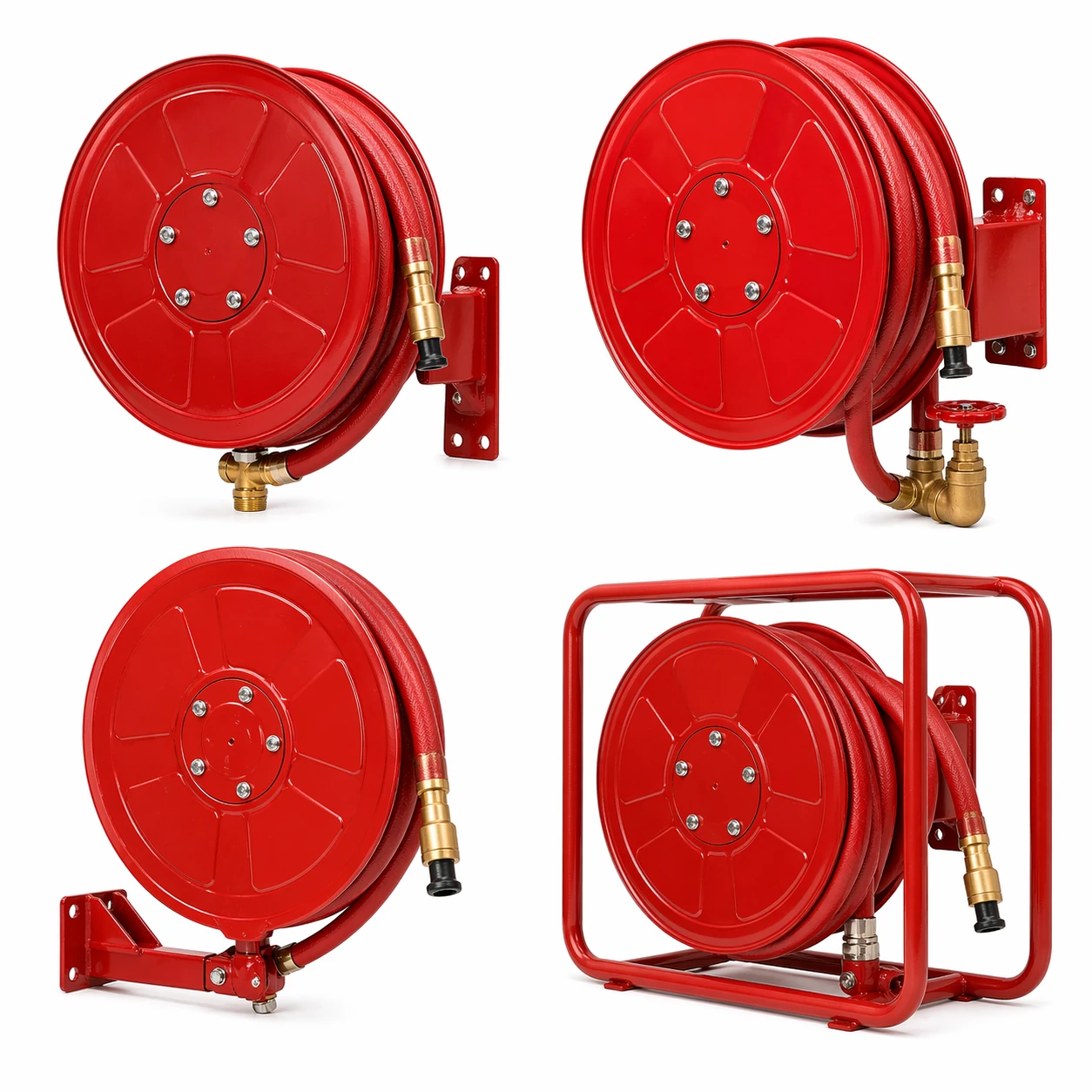
How to Inspect the Sample
A sample shows what the line can produce while it is being watched. Read the reel in front of you alongside the certificates and the production records that came with it, so one careful unit does not end up representing the whole shipment.
- Does the supplier hold valid CCC and CE certification for the fire sprinklers alarm valves products model? Verifies that the supplier can legally produce and export compliant fire hose reels for your market. Supplier provides a current CCC and CE certificate matching the reel model, plus ISO 9001 for QMS. Without valid certification, the sample may not pass import inspection or local authority approval. Request copies of CCC and CE certificates and confirm model scope with the supplier.
- What inspection method will you use to verify the sample against the hose reel standard? Ensures the sample is tested for pressure rating, hose length, and kink resistance per EN 671-1 or GB 15090. Supplier shares a documented inspection checklist referencing the applicable standard and test equipment used. Using an informal or non-standard check may miss critical defects like hose burst or coupling slip. Ask for the inspection checklist and a video of the sample undergoing the pressure test.
- What is the biggest approval risk if we sign off this sample without a full production verification? Identifies potential deviations in material grade, assembly tolerance, or coating quality that could affect durability. Supplier acknowledges the risk of rework and offers a pre-production sample from the actual production batch. Approving a hand-built sample can lead to rejection of the bulk order due to manufacturing inconsistencies. Require a production sample approval clause in the purchase order and schedule a factory quality gate.
- How will you confirm that the production units match the approved sample after we place the order? Ensures the supplier has a repeatable process to maintain spec across batches, including material traceability. Supplier outlines a first-article inspection and random batch testing procedure with documented results. Without a follow-up plan, the first production run may drift from the sample, causing costly delays. Draft a production verification plan that includes testing frequency, hold points, and reporting format.
Evidence and Approval Documents to Keep
At this stage, the record needed before the next stage is a completed quote request specification sheet with supplier-confirmed tolerances and a signed approval document. Use this ordered list to track every document:
- quote request Specification Sheet – Contains hose diameter, length, working pressure, material, reel type, and connection size. Verify certification requirements (e.g., UL, FM, EN) are listed and match your project scope.
- Supplier Test Report – Includes hydrostatic pressure test results, flow rate data, and material certifications. Cross-check against your spec tolerances.
- Sample approval document – Signed by both parties after first production sample inspection. Document any deviations and corrective actions.
- Production Risk Log – Records factory execution issues such as weld defects, coating inconsistencies, or valve assembly errors. Attach photos and measurement reports.
- Final Inspection Certificate – Issued before shipment, confirming all items meet the approved spec. Include a checklist of critical dimensions and functional tests.
Keep these records in a shared folder accessible to your procurement and quality teams. For more on our process, visit About Us.
Bulk Production Risks and Change Control
Before approving a production run, verify that the supplier’s sample matches the quote request specification sheet exactly. For catalog products reels, this means confirming hose diameter, length, working pressure, material, reel type, and connection size against the written requirement. A single deviation—such as a different hose lining or reel bracket—can affect installation and compliance.
Use this practical checklist during the quote request and sample handoff:
- Compare supplier response with the approved specification, sample, and quotation.
- Require a signed change control form for any material or dimension substitution.
- Ask the supplier: “What is your process for notifying us of a production change before shipment?”
- Request a pre-production sample from the first batch and test it against the approved sample.
- Confirm that the quoted price includes all specified components and no hidden cost adjustments for standard tolerances.
Bulk production risks increase when change control is absent. Without a documented agreement, a supplier may substitute a lower-cost hose or reel without notice, leading to field failures or rejection by inspectors. The buyer’s verification question should be: “Does your factory have a written change control procedure that requires buyer approval before any spec deviation?” If the answer is no, require one in the contract.
| Checkpoint | Buyer Verification Question |
|---|---|
| Sample match | Does the sample match every parameter on the RFQ spec sheet? |
| Change notification | Will the supplier inform you in writing before any production change? |
| Cost impact | Is the quoted price locked unless a change is approved? |
| Pre-production sample | Can you inspect a sample from the first production batch? |
By enforcing these checkpoints, you reduce the risk of receiving non-conforming goods and maintain control over cost and quality. The goal is to ensure that what was quoted, sampled, and approved is what gets delivered in bulk.
RFQ Handoff and Supplier Questions
At this stage, ensure the quote request specification sheet contains all required parameters and supplier questions are defined before sample ordering. This step is critical for avoiding costly mistakes.
Before sending the quote request, confirm that your specification sheet includes critical parameters such as hose diameter, length, working pressure, material, reel type, and connection size. Also verify that tolerances are clearly stated. This prevents miscommunication and costly rework.
When handing off the quote request to suppliers, include these questions to validate product fit and supplier capability. The questions are designed to cover specifications, cost, quality control, sample handoff, and factory execution. For a comprehensive list of fire hose reel specifications, review our product range.
- What are the exact hose dimensions and working pressure for your standard fire hose reel?
- Can you provide a cost breakdown per unit for the specified configuration?
- What quality control checks are performed during production to ensure dimensional and pressure consistency?
- How do you handle sample requests and what documentation accompanies the sample?
- What is the typical process for factory inspection and shipment verification?
After receiving answers, evaluate each supplier’s response to confirm they match your requirements. This structured approach reduces risk and ensures the sample meets your expectations. These questions help you compare suppliers on an apples-to-apples basis.
Source check: Choose a fire hose reel by insiders’ advice; Top 10 Questions to Ask Your Fire Equipment Supplier Before Ord…; Fire Hose Buying Guide for U.S. Procurement Teams: Specs, Stand….
In conclusion
The sourcing choice for a fire hose reel ultimately comes down to comparing your verified specification checklist against the supplier’s documented capabilities. Before shortlisting, confirm that the quoted MOQ and cost align with your quote request, and verify that the lead time—typically 35–60 days for standard production after specification confirmation—matches your project schedule. Document every tolerance and material requirement, then approve only after the supplier has provided a first production sample with measurements that match your checklist.
To close the procurement loop, check that the supplier can supply certification documents on demand, such as CCC or CE for the product family, and request the applicable UL test reports if needed. This approach minimizes risk by ensuring that every parameter—from hose diameter and working pressure to reel type and connection size—is locked in before the order moves to production. A disciplined handoff from quote request to sample approval to final order protects both specification integrity and delivery reliability.
Frequently Asked Questions
What inputs should buyers confirm for fire hose reel specification?
Confirm hose diameter, length, working pressure, material, reel type, and connection size. Verify certification requirements (CCC, CE) and request UL test reports on demand. Baseline MOQ is 200 pcs for standard products; confirm in quote request. Sample lead time is 15–20 days, production 35–60 days after spec confirmation. Check supplier’s ISO 9001 QMS certificate. Approving the wrong structure or supplier proof can create quality, cost, or delivery problems.
What sample evidence is needed for fire hose reel specification?
Request a first production sample with documented measurements against your quote request. Verify hose kink resistance, coupling fit, reel rotation, and pressure test. Require CCC/CE certificates and UL test reports. Compare sample to approved spec and shortlist suppliers who provide a sample approval report. Signing off an unverified structure or proof file can create quality, cost, or delivery problems.
What should be included in a fire hose reel specification RFQ?
Include hose diameter, length, working pressure, material, inlet/outlet size, reel type (manual or automatic), certification requirements, packaging, quantity, and delivery schedule. Request MOQ, lead time, and sample policy. Verify supplier holds ISO 9001 and can provide CCC, CE, and UL test reports. Approving a structure or supplier proof that does not match the spec creates quality, cost, or delivery problems.
Fire hose reels: what’s the difference in the field?
Fire protection reels follow standards like EN 671-1, with semi-rigid hose, automatic shut-off, and higher pressure. Operational wash-down reels may use lower-pressure PVC hose and lack certification. Confirm the intended use and verify the specification matches the required standard. Risk of non-compliance if misapplied. Ask how QC will check the sample, color, finish, packing, and bulk order.
Is the reel for fire protection or operational wash down?
If for fire protection, the reel must comply with fire codes and be certified (CCC, CE). Wash-down reels are simpler and lower cost but may not meet code. Check the supplier’s product range and confirm in the quote request. For fire protection, expect higher cost and MOQ due to certification and material requirements. Ask how QC will check the sample, color, finish, packing, and bulk order. Accepting an unverified structure or proof record creates quality, cost, or delivery problems.
quote request handoff: Send Specs for Review.